

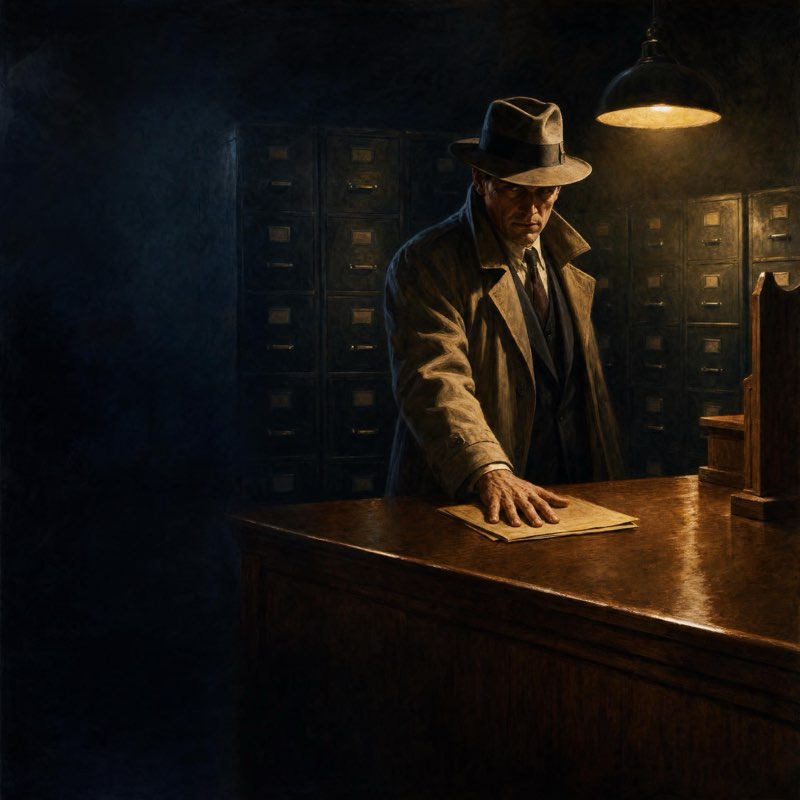



Same for Everyone
He pockets her petition and promises to carry it to the one clerk in the city who can't be bought — still believing honest is the same as safe.
Pinned to the Corkboard and will not be contradicted by a later case.
Closed for good. The dead stay dead, and the canon is append-only.
Segment one · A Name of Her Own
[tired, world-weary] There's a hall downtown where nobody ever learned how to take a bribe. Marble underfoot, a clerk behind brass, a stamp that comes down the same for a judge as for a washerwoman. For twenty years I called it the safest room in Calloway Bay. Then a tired woman put a folded paper in my hand, and before it was done it cost her everything she had left.
She came around the corner the way people do when they've learned not to be seen — no shine to her, no angle working. Just a woman in a good coat gone thin at the cuffs, holding the folded paper in both hands. Somewhere down the hall a date-stamp kept coming down, steady as a clock.
[scared, holding it together] You're the detective. They said you'd meet me here.
You picked the spot. Why the bureau?
Because here a thing has to be true.
True how?
My name. I want it made mine for good.
You've got a name. It's on that paper.
I made this one. Sayre. With my own hands.
And the old one?
I married it. I'd scrape it off if I could.
Scrape it off how?
Seal the old page. Strike the married name. Swear the new one's mine.
That's three things. Most people want one.
I'm not most people. I'm done running.
Running from what?
A husband. The kind the neighbors call a gentleman.
He hurt you.
He was careful. The marks never showed.
She said it the way people say the weather, and that told me more than the words had. Careful is a word you only use about a man you watched learn to be it.
You could go to the law.
I went. They sent me home. He drove.
So you ran.
Three cities. This is the fourth one.
And now you want to stop.
I want to be somebody again. On paper. Legal.
Paper's just paper.
Paper's the one thing he can't charm.
She believed that, all the way down, and I could hear how much she needed to. A woman that tired doesn't build a lie. She builds a door and prays it holds.
There's a clerk at vital records. Dunlevy.
Is she honest?
The kind money never learned how to touch.
Then she'll help me.
She won't bend for anybody. That's her whole trade.
I don't need her to bend. Just to be fair.
Give me the petition. I'll carry it in myself.
You'll keep it safe?
Safest room in the city. I told you.
She let go of the paper like it was the last warm thing she owned, and I told her again that an honest clerk was the same as a safe one. Twenty years in the trade and I still believed it, walking her petition down the marble toward the one desk in Calloway Bay that had never once learned how to lie.
Segment two · No Mercy, No Money
Afternoon. I've got a petition that wants filing.
State the relief sought. Her name as it stands today — you have it written?
It's all on there. She wants her old name sealed. Off the record for good.
Off the record. You mean struck.
Struck, sealed — whatever the word is on your side.
The record keeps no word for struck. Learn that one first.
All right. What's the second thing I learn?
A name isn't undone because it turned inconvenient.
This one's past inconvenient. The lady's got reasons.
Everyone at this counter has reasons. The page doesn't rank them.
You've never once looked the other way?
Looking away is how names get stolen. I keep them.
Keep them for who? Nobody reads these but the dust.
Someone always reads them. That's the whole reason they're kept.
I'd worked counters like hers before. Every one had a soft place if you leaned on it slow enough. I started leaning.
What's the fee for trouble this size? Name it, I'll meet it.
The fee is two dollars. It files the paper. It alters nothing inside it.
You think I'm talking about two dollars?
No. You're asking me to write a lie, or rub out a fact.
I'm asking you to help a frightened woman.
Then I help the next man who comes to erase one.
You'd hand a woman to whatever's chasing her, for a rule?
I'd keep the rule. What's chasing her isn't my counter's business.
There's no next man. There's her, tonight.
There is always a next man. It holds for her because it holds for all of them.
And there she was — not bought, not budged, and not sorry for either. I'd stood in front of that patience once before.
A long time back a clerk entered me the same way — every particular set down, height and eyes and the things I don't explain, and the line for the name left honestly blank, because I gave her none and she wouldn't invent one. Same breed. You don't buy it and you don't move it.
So that's a no.
It's no. But the petition still files.
Files how, if you won't grant it?
Everything on it files. The name she carries now, the name she left, the street where she sleeps — dated, denied, and open to anyone who asks.
And if the open truth gets her hurt?
Then it got her hurt. It still goes down true.
She wet the pad and brought the stamp down once, square in the corner, and that was the paper's whole answer.
Can't you date it and shelve it? She'll find another road.
It isn't shelved. It's open. That was the point of keeping it.
Open or shut, it reads the same to me. A no.
Read it how you like. The page says what it says.
I buttoned my coat and left her the paper and the sour afternoon stapled to it. All the way down the stairs I was turning over how you tell a scared woman her last clean road is closed — like that was the heavy thing in my pockets, like a no was the worst I was carrying out of that hall.
Segment three · Nowhere to Hold Still
[dry] You've got the face on. The losing one.
Nobody lost, Dale. That's the trouble with it.
Sit. The rain's early and so's your sulk.
Dunlevy wouldn't move. Not money, not mercy.
Dale heard the whole case in that one sentence. She always does — she's got an ear for the exact spot where a man ran out of road.
Then she's the one straight thing left downtown.
The woman wanted her name made real. I couldn't get it for her.
How'd she strike you, this client?
Tired. Honest. No angle at all.
Those are the ones that stay with you. Leave the bottle be — you'll want to remember this one.
I'm not reaching for it.
You were thinking about it. I can tell from here.
She said paper's the one thing he can't charm.
She's not wrong. She's only early.
She's got no legal road out. None at all.
And you walked her straight at the wall. What did she want it for?
To stop running. To be somebody.
No. Listen to your own self for once.
She's run three years—
And she's sick to death of it. She came to STOP.
Same thing, in the end.
It's the opposite thing, sunshine.
Then spell it out for me.
She set my coffee down in front of me and left her own where it stood, untouched. The rain had come in late and crooked on the glass, and she let the quiet take one slow turn of the room before she said the thing she'd already made up her mind to say.
A woman who files to be somebody has to hold still while the ink dries. One spot, her own name, said out loud. The only thing that kept her breathing in this town was being nobody — no name, no street, no forwarding address.
She asked me for help. I helped her.
You helped her hold still. For a man who's good at finding what stopped moving.
She let that one sit the way she lets a thing sit when she means for it to bruise. I didn't have anything to set against it.
[quietly] I thought honest was the same as safe.
Honest is honest. Safe is a different word, and you know it.
So I set the trap myself.
You ran her paper to the one desk that can't be bought, and never once asked the only thing that counted — whether a woman like her can afford to hold still long enough to sign her own name.
Segment four · His Turn Comes
I went back after the lamps were lit and the public had gone home, meaning to take her paper out of the drawer before the city woke up knowing where she was. The whole hall was dark but for one green lamp burning at the records counter, and the woman under it hadn't gone home either.
You keep late hours, Dunlevy.
[soft, level] The work keeps its own. What do you need?
The Sayre petition. I want it pulled.
It can't be pulled. It's entered.
Then lose it. A drawer sticks. A card slips.
Not at this counter.
One card. Nobody would ever know.
I would know.
She built that name to stay alive. You see that?
I don't doubt it for a minute.
You remember her. Sayre.
I remember the petition. I don't keep the women.
Mercy, then. After dark, with no one here?
Mercy's not mine to hand out.
Money. Name a number and it's yours.
You've met me. You already know better.
Has anyone else come asking for this page?
Let me look.
There's already a request standing against it. A husband, asking after his wife. His standing is as good as yours was an hour ago, and when he asks I'll hand him the very page I'd have shown you. I didn't write her street onto it. You carried it in this morning and did that yourself.
There wasn't a drop of cruelty in it, and that was the whole horror of the thing. She would do to him exactly what she'd done to me, to the letter, and call it fair, and she'd be right to.
[close] Prewitt.
Carl Prewitt. A lawful husband.
You can't answer that man.
I answer anyone with standing. I answered you.
She had. She'd answered me honest and square and open-handed, and now that same honesty was turned the other way, pointed at the one woman it would finish.
I came to help her. He means to do worse.
The counter can't tell the two of you apart.
Then tell us apart. Just you. Nobody's watching.
I'd be watching. That's enough.
Make the one exception. Just this once.
And the next soul who needs this page to hold finds it already bent.
She'll be found inside a week.
I didn't send him. I only answer when I'm asked.
When does he get his answer?
When he asks across the counter. The stamp's already inked.
You know whose turn comes next.
I know whoever asks next with standing gets the same page. That's the whole of it.
I'd carried her paper to the one honest hand in Calloway Bay because honest had felt like a wall between her and the man. Standing there in the dark I finally heard what Dale had heard at noon — that I had done his finding for him, drawn the map straight to where she slept in my own hand, and left it on a page he had every lawful right to walk in and ask for.
Segment five · What the Law Allows
The street was the kind that waters its hedges on a schedule. Prewitt's house sat behind a clipped one, white and square and well-mannered, a house that had taught itself to look like it had never once raised a hand. I went up the walk to warn a man off, and the man opened the door before my knuckles landed, as if he'd stood on the other side of it all evening, waiting to be reasonable at somebody.
You're the detective. Come in out of the cold.
Sit anywhere you like. I keep a warm room.
I won't be long, Mr. Prewitt.
Carl. Be as long as you need.
I came about your wife.
I've been hoping somebody would.
She left you.
She's unwell. She wanders off.
Three cities is a long wander.
A frightened woman goes a long way.
Frightened of what?
Her own notions. She has a great many.
Something to warm you? It's a raw walk.
No. She says you hurt her.
She says a great many things. You can't show a court a thing that isn't there to show.
Careful work. No marks.
A careful man keeps a clean house.
You've been looking for her.
A husband's allowed to look.
Allowed by who?
By the law. I read up on it.
I can make this loud for you. The papers.
What would you tell them? That I asked after my wife?
I'd think of something.
I've broken no law. Be as loud as you please.
And I don't need to go find her. That's the part you came to stop, and there's nothing in it to stop. I filed a request downtown, the honest kind, a man asking after his own wife. When her name settles onto a page, the clerk is bound to tell me where it sits. I only had to be patient and wait for her to want to be somebody again.
He said it the way other men say grace. Behind him a mantel clock kept the only honest time in the house, patient as he was, and I felt the shape of the trouble settle over me. I'd come to lean on a man who had given me nothing to lean against — no pistol to lift off him, no threat to carry anywhere, nothing in that warm parlor but good manners and the stillness of a man who already knew he'd won.
You won't find her. I'll see to that.
You won't have to lift a finger. The county will.
I'll move her first.
Then she runs again. That's no life for her.
Better than the one you gave her.
You've had a cold walk for nothing. Let me thank you for your trouble.
Don't.
[warm, almost gentle] I expect the county will be in touch any day now. When they are — tell her I kept her supper warm.
Segment six · Nameless, And For Good
Her room was half a room by the time I got there — a case open on the bed, a coat folded over the one chair, a life she'd already decided to carry out in both hands. She looked up like she thought I might be bringing her the only thing in the city she still wanted. I was bringing her the opposite, and it was going to cost me something to set it down.
You went. You saw her. Tell me she signed it, mister.
She didn't sign it, Mrs. Sayre. She won't.
Then we find somebody who will. There's always somebody.
Not her. Not that counter. That's the whole trouble.
I went there to be made real. Lawful. A name on the page that nobody could take off me.
I know what you went for.
So why is it a no?
Because the page keeps everything. That's the point of it.
Keeping me is what I wanted.
It keeps the old name too. The one you ran from.
You mean it ties them together. The woman I was. The woman I made.
On one line. Your hand did it when you filed.
I filed to be safe.
You filed a road to this door. And the stamp that marks it doesn't know you from anybody.
He'll ask for me. Carl will. And they'll — they'll just answer him.
Same answer they'd give a stranger. That's what makes them honest.
[voice trembling] Then tell me how to stay. How to hold still and be somebody.
You can't. Not the lawful way. Not now.
So I go back to being nobody.
This time you stay nobody. No paper. No fee. Nowhere that keeps a record of it.
The thing I came to stop.
There's a kind of leaving the city can't sell you and won't write down. I bought it once. For myself. Walked out from under my own name and left no line to find it on.
And it held.
It held because nothing remembers it. That's the price. You'd be free the way a thing nobody's written down is free.
The one place in this whole town that won't lie to a soul. And it's the place that won't save me. Why is that, mister?
I'd carried a lot of bad answers up a lot of stairs. I didn't have one for that. The honest counter and the locked door were the same counter — straight with her the way it was straight with the man coming for her, and she could hear that I knew it.
Segment seven · A Breath Ahead
[hushed, glancing over his shoulder] Grip in your hand, Lorna. We're leaving.
You said he couldn't buy the clerk. You swore it.
He didn't buy anybody. He didn't have to.
Then how is he on my stair?
You put the address on a county page. In your own hand.
I put it there to be someone. To stop running.
The page doesn't know the difference. It answered the next man who asked.
And the next man is him.
The next lawful man. Same thing to the ink.
I did every last part of it the lawful way.
That's the catch. Lawful cuts for whoever's holding it.
A tread groaned down below us, then the next one, slow and sure, a man climbing like he had the deed in his pocket.
That's his foot on the stair. I'd know it in the dark.
The window. The alley runs to Fell Street. Don't stop at the corner.
She got the sash up with two hands like it weighed nothing, and the wet night air came in off the brick.
Come with me. Please.
I'd only slow you. Go — now.
I came here to hold still. That's all I wanted.
Hold still later. Run tonight.
Then she was over the sill and gone down the iron, and the stair outside my door fell quiet, and the stair inside filled up with the sound of him arriving.
Good evening. I'm looking for my wife.
Wrong floor, mister.
No. The county was kind about it. They gave me the number in her own writing.
They hand that to anybody with a form?
To any husband who asks it properly. I asked it properly.
So you followed a slip of paper up three flights.
I followed what she signed. She wanted it set down true. It's true.
She wanted a name. Not a map to her door.
Those were always the one paper, friend. I only read what was there.
And there he stood, hat still on, not a mark on his knuckles, the whole thing done for him by a clean hand that had never once looked up.
May I see the room?
She's not in it.
Then there's no harm in my looking, is there.
He put his head in and took the measure of an empty room the way you'd read a weather report.
Tidy. She always kept a place tidy. Even the last one.
Go back down the stairs, Prewitt.
I broke no law coming up them. You of all people know what a clean record's worth.
A clean record's worth nothing to the one it points at.
It points where it's told. I only told it the truth.
...Down the stairs.
Give her my regards. The county has the address. I won't need the stair twice.
I stood on the landing and listened to his steps go down as even as they'd come up. A long time back I'd let a fair clerk enter me with the name line blank and called it shelter — a page nobody could bend, built so no small soul ever got rubbed out, and I'd thought that was a mercy. Tonight the same even hand had drawn this one a map straight to the woman it was made to keep, and she was off down the alley with nothing on paper to say she'd ever been born. The man who broke no law had the one thing that lasts in Calloway Bay: an address, and a mark that never once lied.
Segment eight · The Same for Everyone
You're here early, Dunlevy.
I'm always early. You look like you didn't sleep.
Prewitt came. Last night. The husband.
He came here first. Yesterday, across this counter.
And you gave him the page.
I stamped his request the way I stamp them all.
The same stamp as hers.
The same ink. The same hand. It doesn't learn their names.
Down the counter the stamp came down on somebody else's morning, the same flat knock it made the day she first folded her paper into my hand — fair to a judge, fair to a washerwoman, fair to the man with the healed knuckles who'd walk out of this city free as weather.
She was gone by a breath. No thanks to this counter.
The page said where she'd been. It was true when I wrote it.
True and a knife, both at once.
Every true thing is, to someone.
You could have warned me he'd asked.
I don't carry word between the people who come to me.
No. You just hand out the page.
I hand out what's true. That's the whole of my work.
She ran because of a thing I called safe.
I didn't send him. I only answer when I'm asked.
Tell me it's unfair. Once. Just to me.
I can't do that.
Why not?
I had nothing to set against her, and we both knew why. I'd let a page like hers take me down once, every line but the name, and I'd paid for the fairness that was finishing this woman long before she ever came through the door. A man can't call a thing crooked when he bought it straight with his own two hands.
It's the same for everyone. That's the only thing that makes it worth keeping.