

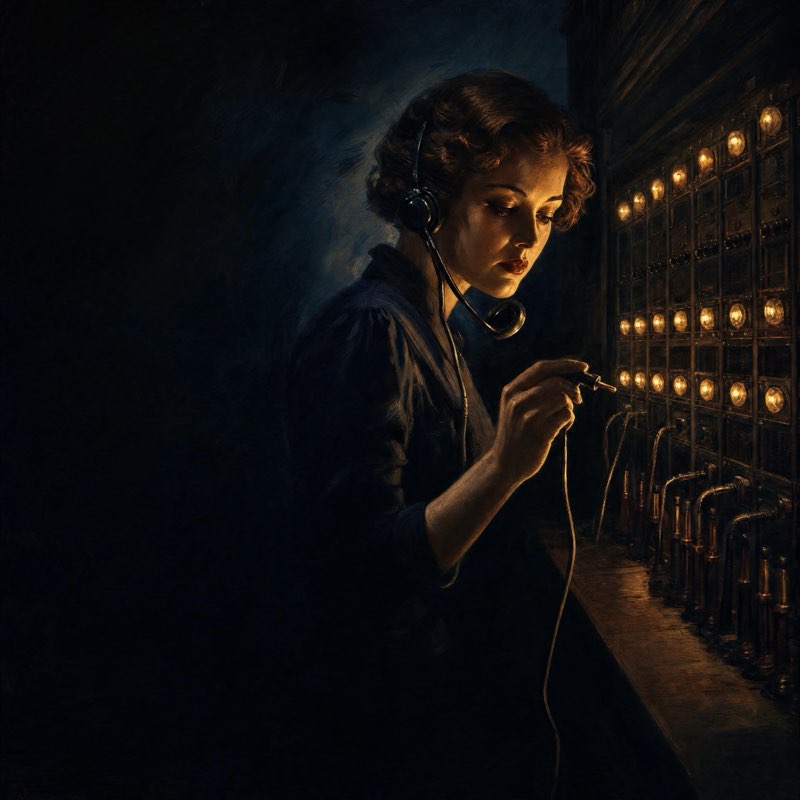



Not Yet, Not Yet
She puts the spare headset in his hand at the hour it always comes, and two women he will never see say 'not yet, not yet' into his ear.
Pinned to the Corkboard and will not be contradicted by a later case.
Closed for good. The dead stay dead, and the canon is append-only.
Segment one · Hired on a Sound
Sit. Mind the cords — this is a working board.
You're Ruth Enright. You called me about a sound.
I did. And I don't call men out in the rain for nothing.
What is it I'm supposed to hear?
One line. It crosses every night, the same hour.
Lines cross. That's a loose wire, not a case.
A loose wire doesn't keep the same company.
Meaning what?
Two women. The same two, three weeks running.
You know them?
A tenant line. An old woman and the girl who minds her.
Then why not just pull the plug?
Because I keep a clean board, and this won't clean.
And you want me to tell you you're not going soft.
I want you to tell me what I'm hearing. Can you?
She put the spare set in my hand. The hour it always came was a minute off, and getting closer.
[frail, quavering] Winnie? Is that you, child?
[clear, careful] It's me, Aunt Pearl. I'm right here.
[frail, quavering] Tell them not yet. Not yet — you'll tell them?
[clear, careful] I told them already. Not yet. Rest now.
[frail, quavering] Not the ward. Don't let them. Not yet.
The old woman's not-yet had a tune to it, worn smooth from saying.
There's a man on that line too. Hear him?
No. Just the two women.
Nobody hears him. Not one word, three weeks.
Same hour tomorrow?
To the minute. You'll take it?
I'll listen. I don't promise more than that.
So I took a job off a sound and nothing else — no client I could point at, no body, no crime a cop would bother to write down. Just a lady operator, a fault in the wire, and two women I would never lay eyes on saying not yet, not yet into my ear, like they were holding off something already standing in the room.
Segment two · A Map of the House
This is the whole house, in two hundred jacks.
Show me the one that won't behave.
Here. Room nine — the Dyer line.
The old woman from last night?
Pearl Dyer. Bedridden. The girl's her niece.
The niece — you've met her?
Once. Quiet thing. Carries trays, carries silence.
And the crossing's always this jack?
This one and the trunk beside it. Every night.
The same hour you said. How close?
Inside a minute of nine. You could set a watch by it.
Lines don't keep office hours. Someone's calling in.
She slid a pasteboard slip across the desk, the way you'd lay down a card you'd been holding all night.
The house books it. A toll call, every evening, paid downstairs.
Paid by who?
A trustee's account. I see the charge, not the man.
A man pays to telephone a sick woman. Nightly.
To hear her, the clerk says. Just to hear her voice.
Hear her say what?
The same thing you heard. Not yet.
And the girl? She's on the call?
Always. She answers for the both of them.
Not yet to the county ward. Not yet to letting the girl go. The slip didn't say that, but the arithmetic did.
If the old woman stops needing minding, what happens to the niece?
That's not on my board. I run lines, not families.
Humor me. The money follows the need, doesn't it?
I suppose it would. The keep stops, the keeper's done.
So the house needs her needing. Every single night.
I only called you about a sound.
You called me about a house that can't afford a cure.
Will you say it plain? Is my board broken or isn't it?
Your board's fine. It's the house that's got the fault.
I walked out past two hundred jacks that all behaved, and the one that didn't. Same two holes in the same board, lit at the same minute every night, crossing a call the house paid good money to have placed — a telephone wired, in the end, to keep one old woman exactly as sick as she was worth.
Segment three · Alive on Paper
You're in luck — Flynn, Chronicle morgue, and it's a slow night.
I need a name run down. Quiet.
Quiet costs extra. Who?
Dyer. Pearl Dyer. An old woman, an invalid.
Dyer, Dyer — hang on.
Here she is. She's real. Taxes, tenancy, the works.
Alive?
On paper, breathing. No death notice, and I'd know.
You'd know a death notice?
Every one in this city crosses my desk. She isn't there.
What's she live on?
A trust. Small one. Pays her keep and not a dime past it.
Who holds it?
A trustee downtown. Pays out while she still needs keeping.
And when she doesn't?
Trust's done. County takes the invalid, closes the file.
The niece. Is she in it?
Named. As keeper. Nothing more — no heir, no share.
Every line Flynn read fit the next one like the bars of something built to hold a person without ever once touching her.
Say — is this for a story? Because I could use one.
It's not a story. It's a favor you owe me.
The Farrow business. Right. I remember.
So I didn't ask, and you didn't tell me.
Didn't ask what?
Exactly.
I kept the board and the voices out of it. Flynn chased money for a living; a dead woman on a wire was a headline, and this one wasn't going to be anybody's.
What, on paper, binds the girl to the house?
Guardianship. She's the old woman's hands and feet.
So the day Pearl's well, or gone, the girl's loose.
Loose into nothing. Her name's on nothing that pays.
Everything she has depends on an old woman needing her.
Cold, when you put it flat. But legal. Dead legal.
That's the trouble. It's all legal.
So there it was, in the city's own hand: Pearl Dyer, alive, real, tenant in good standing, kept by a trust that paid only as long as she needed keeping. Not a line of it broke a law. I had a house, a motive, and a wire that lied — and nowhere in the whole clean stack of paper a single place to put the word crime.
Segment four · One Breath for Two
I came back at the same hour with nothing in my pockets and nothing to prove, just a borrowed headset and the two voices this city kept slipping me for free.
There's your hour. Same two jacks, right on nine.
Tonight don't give me the words. Give me the gaps.
The gaps?
When one stops and the other starts. How long?
You want me timing ghosts now? That's your work.
Tonight it's yours. Ready — here they come.
[frail, quavering] Winnie? Is it you, child? Not yet...
No gap. The girl was already answering.
[clear, careful] I'm here, Aunt Pearl. Not yet. I told them.
Again. How much air between the two?
I can't catch it. They don't leave me the room.
And the man under it — still nothing?
A hum. Could be him. Could be the wire itself.
[frail, quavering] You won't let them take me? Say it.
[clear, careful] I won't. Not yet. Hush now.
There — did you hear it? She stops, and the girl just goes.
The old woman never draws breath to answer, does she?
No. The breath's gone before the answer comes.
Most people breathe over each other, step on each other, race for the next word. These two passed the air between them and never spilled a drop.
There was a man once, Frankie Slim, who heard everything this city said, until the city heard him back and took him out from under the el for good. He'd have named this in one pass. I'm slower, and still breathing, which some nights feels like the worse trade.
You said three weeks. Was it this tight at the start?
No. At first they overlapped, like anybody. It drew in.
Drew in how?
Closer. Smoother. As if they'd been rehearsing.
People don't rehearse being sick.
Then what am I listening to?
Maybe less of the old woman to wait on, each night.
Don't say that on my board. It's an ugly thing.
It's an ugly line. I didn't string it.
[frail, quavering] Not yet... not yet...
[clear, careful] Rest, Aunt Pearl. I'll tell them again tomorrow.
Less of her every night, and more of the girl.
Find me one clean gap tomorrow. One, and I'll drop it.
And if there isn't one?
Then one of them's breathing for both.
Two voices, and between them one breath — the old woman emptying her lungs at the exact beat the girl filled hers, the handoff clean the way it only ever goes when there aren't really two people to hand anything off between.
Segment five · Where the Voice Slips
It's a bad night for lines. The storm's in all of them.
Never mind the storm. Put me on the Dyer jack.
You're on it. Near enough nine. Listen.
She seated the cord without looking. Three weeks had taught her hand where the trouble lived.
[frail, quavering] Is it evening? Winnie, is that you?
[clear, careful] It's evening, Aunt Pearl. The man's on the line.
The trustee's call — he's on it now?
He's on it. That hum. Putting his questions, same as ever.
[frail, quavering] Tell him not yet. Tell him I want her by me still.
[clear, careful] She says not yet. She still needs me here.
She answers for herself and reports it in one breath?
She always has. I quit hearing it as odd.
And she never slips?
Never. Three weeks, never once.
Something in me leaned toward the headset the way you lean toward a noise in a dark house, a half-second before you know whether it's the wind or a shoe.
Don't touch the key. Don't let her know we're here.
I never touch it. You know that.
[frail, quavering] Not yet. I'm not — I'm not ready to—
[frail, quavering] Not y— [clear, young, unguarded] —yet.
Did you hear that? Did the line go?
The line held. The voice is what gave way.
The voice? What are you telling me?
The frail one had dropped into the young one between the two halves of a single word, and it did not climb back up for air.
[clear, careful] ...not yet. Forgive me — she tires so by evening.
[frail, quavering] Not yet. Not yet, dear.
She brought the old woman back. How did she do that?
One person just remembered to be two.
One person? You mean the niece is what?
I mean one throat's worked both voices. For weeks.
And Pearl? Where's Pearl in that?
I can't tell you. That's the part I can't reach.
If she's not the one on the wire, where is she?
Asleep. Past help. Or neither. I don't have it.
You think she's gone, and the girl's covering?
It's the ugly read. It's also the nearest one.
Is the nearest one wrong?
It fits the sound. That's a long way from true.
One throat had been two women for weeks, and I still couldn't tell you why, or whether the old woman it answered for was asleep down that hall or already gone from it. Only this much held: somebody in that room performed a dying woman every single night — and only ever on the one call the house was paying to make.
Segment six · Packed to Leave
Don't set the receiver down. I'm not your nine o'clock.
Who is this? This is a private line.
It crosses a board downtown. Has for weeks.
Then you've no business on it.
No. And here I am anyway.
I'd heard this voice carry two women three nights running. Up close, with no act to run, it was only one — and younger than the part it had been playing.
What do you want, mister?
To know who you've been talking to at nine.
My aunt. She's resting. Leave her out of it.
Your aunt was on no line last night. You were. Both halves of her.
...You don't know what you heard.
I heard one throat slip mid-word and never climb back.
Under her breathing came a dry rustle — paper gone to a drawer, cloth folded fast. Somewhere behind her a trunk was filling.
You're packing while we talk.
You hear a great deal for a wrong number.
Enough to know the old woman's been gone from this wire for weeks.
She's not gone. She's past the words, is all.
That's the line a niece feeds you while she digs.
Think what you like. I've put nobody in the ground.
Then where is she tonight?
Down the hall. Same bed as always.
She can't say so herself.
No. The sickness took her voice before the rest of her. So I lend her mine.
To a man who only needs two words out of her.
Not yet. That's all he wants. Not yet to the county ward.
And not yet to turning you loose.
The money holds while she holds onto me. That's the whole paper.
And if the money stops?
Then she's a county number and I'm free labor somewhere worse.
You could've handed her to the ward and walked clean.
They don't let the keeper walk. It's written both ways — her kept, me keeping.
So you keep her alive on a wire to buy the days to be gone.
Days. A week at the outside. Then two women nobody misses.
I've only got your word she's breathing at all.
My word and your own ears. Listen past me.
So I did. Under the clasp of a trunk thrown shut, far down that hall and slower than any trick a throat could turn, I caught it at last — one old woman still pulling breath, stubborn and real, alive as anyone the house pretended she had to be. Not a death on my wire after all. Somebody was packing a getaway, and the corpse I'd been half-sure of lay down the hall, breathing.
Segment seven · Three Nights to Gone
I came back to the board on the third night and jacked myself onto the fault before I could talk sense into it — a girl folding her whole life into a trunk while the aunt she carried breathed on behind her, slow and borrowed.
Still here. Still packing.
Three more nights and you'll have your quiet line back.
Three nights to where?
Somewhere with no trustee and no nine o'clock.
You'll not outrun that trust.
I don't mean to outrun it. I mean to vanish out from under it.
People try. The city keeps a ledger on the ones who do.
Not on us. We cost it nothing to lose.
You've drawn his money these weeks. That's a cell, not a train.
I've drawn her keep and spent it keeping her. Count every dime.
And the trust itself?
Pays her keep while she's here to keep. The day she's gone, the money just stops. Nobody's a dollar short.
Nobody but the house, losing its hold on a girl.
The house loses a tenant it rented cheap. That's not robbery. That's a landlord short a room.
She had the arithmetic cold — no one robbed, no one short, a trust that would stop paying out the very day the bed went empty. The only thing set to go missing was two women, and this city doesn't count those until they wash up at low tide.
So what is it you want off the man on the crossed line?
Nothing. I never knew you were there to want it from.
You know now.
Now I'm asking you for three nights of saying nothing.
Three nights of 'not yet.'
Say it with me and it isn't a lie. Not yet. Not yet gone.
The words don't move. Only which way they face.
They always faced me staying. Let them face me leaving. Three nights.
I'd spent a long while being a man nobody could look up — no line in a book, no name worth the ink to set it down. You pay for a thing like that once and go on paying. But it's the one toll in this town they can't collect, because they can never find you to charge it.
You know what you're asking me to help bury.
Nothing. There's no body. That's the whole of it.
A life, then. Off every page there is. That's what I'd be signing to.
Don't sign anything. Just don't speak.
From where I sit that's the same signature.
Is it a crime to want off the list? To stop being somebody's need?
It wasn't. I'd read every statute this town would enforce, and the wish to stop existing on paper wasn't among them. The house was only the city doing its oldest trick — binding a girl with a need and calling the rope care.
No. It's the one thing down here they can't cut a warrant for.
Then let us go. Nobody's hurt. Nobody pays.
Keep saying it.
Saying what?
Not yet. Every night until the trains. Clean as you've learned to.
...Thank you. I won't ask your name.
Don't. I haven't lent it out in years.
Behind her the old woman breathed on, alive and slow, and I'd just put my silence down on the side of two people walking off the only ledger Calloway Bay keeps — the one every other door in town bills you just to try. I'd found the exit that costs nobody a cent. All it had wanted from me was quiet, and quiet I'd been handing out free my whole life.
Segment eight · Nobody Pays This One
No bottle, no slammed door, no ice rattling. Should I send for a doctor?
I'm fine, Dale.
You're never fine. You're between drinks. Which end is this?
Neither. I'm just sitting with it.
Sitting's worse than drinking, sunshine. What's the damage this time?
No damage. That's the part that won't sit still.
Says the man who hasn't struck a key since noon.
Nothing to type. No bill to send.
Enright hired you. Enright pays a fee.
I'll send her the hours. Not the answer.
Half a bill. That's a first for this office.
She hired me to name a sound. I named it. The rest I'm keeping.
The rest being the two women you won't talk about.
You don't need the rest of it.
I never need it. I just enjoy watching you hold it.
So who's left holding the check? The aunt? The house downtown?
Nobody. That's what I keep turning over.
Nobody. In Calloway Bay.
Not a soul.
You know what this town is. Every way out of it has a fare on it.
A steamer ticket, a bent cop, a plot with your name cut in the stone — and always some poor devil left on the dock holding the tab.
This time the two who left owe nothing.
And the ones they left behind?
Out nothing. Not a dime, not a name, not a night's sleep.
A leaving with no fare and no sucker to pay it. Eleven years at this desk, and I never once wrote that down.
She pulled the cover over the typewriter and the little room went quiet the way a street goes quiet after the last streetcar — not empty, exactly. Just done for the night.
Most folks go out owing. These two just go.
And I let them.
Then there's nothing to add up. First book I ever balanced by leaving every column empty — and it's the only one that ever came out clean.
I let the blank column stand. In a town that prices every exit down to the nickel, Dale had just totted up the rarest leaving it ever handed me — one with no fare in the ledger and nobody on the dock holding the freight. I had nothing to write and no one to send it to, and this once that was the whole clean truth of the thing.
Segment nine · A Fault Let Stand
Morning came up grey off the harbor, and Ruth's board, that had crossed two women onto my ear for a week, ran clean — nine o'clock come and gone with nobody on the line.
Nine passed. Nothing crossed it. First quiet night in three weeks.
Then they're gone, Ruth.
Gone where?
Out. That's as far as I followed.
And my fault? The two jacks?
Pull one. Have a look.
She drew the cord and the line came up empty — a clean pair of jacks with no ghost strung between them, the way the board should have read all along.
Clean. Like it never crossed at all.
It crossed. A fault in the frame — two jacks seated too near, bleeding one call onto the next.
That's not what we heard, and you know it isn't.
It's what the line did. The rest was never the line's to tell.
You mean to write it down a fault.
I mean to write it what it was. A fault on the line.
I took her log, found the column for the hour, and set down the one word that explained the sound and buried the leaving in the same stroke.
There. Fault.
One word. All those nights, and one word.
The word's true. Everything it leaves out is true along with it.
And the girl? The old woman down the hall?
Not in your book. Not in mine. Nowhere a soul can look.
I heard what you heard, mister. Every night of it.
I know you did. That's why it's your log I wrote in, not just mine.
She read the one word I'd left her — the only other ear in this city that knew the size of what it covered — and she set the book down open on it and reached for her morning line. A fault's a fault. She let it be one.
Fault on the line. I'll mark it cleared itself.
It did. Near enough.
I signed off on the one leaving Calloway Bay would keep no ledger on, turned up my collar against the cold coming off the water, and walked out into the morning carrying nothing — no client to answer, no name on a page, no weight for the drawer. Nothing at all. Which, this once, was the whole of what the job had been.