



Good Night, and Be Forgiven
She swears the voice absolving strangers on the air is the man who killed her husband, and the detective, telling this from the far side of it, already knows he has nothing but a voice to hang a dead man with.
Pinned to the Corkboard and will not be contradicted by a later case.
Closed for good. The dead stay dead, and the canon is append-only.
Segment one · A Voice She Buried
You want it in order, so here it is, the way I'd set it down for a file nobody's ever going to read. It starts in a widow's parlor with the lamps off and the radio turned down to a whisper. On the air a warm voice was forgiving a stranger who'd telephoned in his sins. The Hour of Mercy, they call it. Ten to two, six nights a week, a voice with no face telling the whole town it's absolved and can sleep now. I sat in the dark and listened to a dead man forgive somebody else.
The widow hadn't touched the tea she'd poured me. She'd called me plain that afternoon, no tears in it, the way you'd report a leak in the roof.
I buried that voice three years ago, mister. I put it in the ground myself, in the rain, with a priest who meant every word. I never saw his face clean, it was dark and it was fast. But I'd know the sound of him in my sleep. And I have. Every night at half past twelve he's here on my own set, telling this city it's forgiven.
Say you're right. Say the man who put your husband under is the man on that dial. What is it you want done about it?
Not the rope. I thought that was it, the whole way over here, but no. Not the gallows. Something else. Something I haven't got the word for yet. I only know that when I hear it, I'll know it's the thing I came for.
I'm telling you this from the far side of it, so I can say now what I couldn't say to her then. She was right about the voice. Dead right. And a voice was all I'd ever get, no face, no paper, no gun still warm. In this town you can be certain down to the bone and still hold nothing a judge will take off your hands. I had a dead man to hang, and only the sound of him to do it with.
Segment two · Behind the Glass
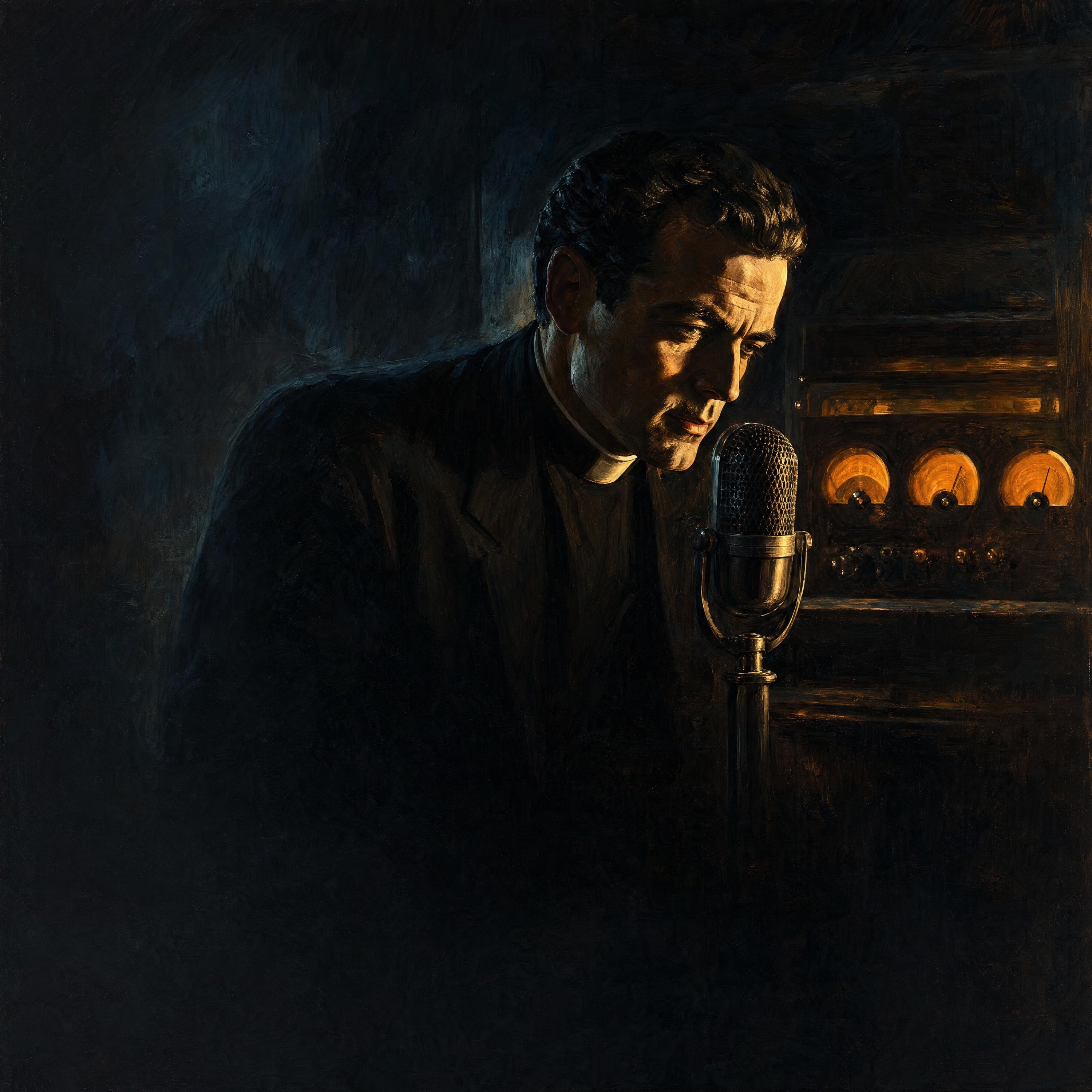
The station sat up over the harbor with its red light burning, and the transmitter shack out back hummed like a held note that never resolves. Through the glass I could watch him work, the Padre, a faceless man in shirtsleeves forgiving the city for a sponsor's money, and never once looking up from the microphone to see who'd walked in out of the dark.
I'd brought an old transcription disc, a scratched thing three years dead, his voice from before he was supposed to be. I set it turning low against the live wire and listened to both at once. There it was, the catch the widow's ear had caught, a small held breath before every hard word, the same on the disc as on the air. I'd been here before, in a way. Not long back a blind man who tuned church organs named a killer for me off a single wet cough in the dark, and he was right, and it bought him exactly nothing the law would carry. The ear is a witness that can never be sworn.
Then the voice that had been forgiving strangers all night turned, mild as milk, and forgave me for standing there. The little monitor on the wall crackled with it.
You've been listening a long while, friend. Longer than a man listens for his own comfort. Come up to the glass. I don't frighten anyone, I haven't a face worth the fright. Whatever you carried up that hill, you can set it down here. That's all this hour is for. Even yours.
I know your voice. So does a woman across town who's heard it in her sleep for three years. You forgive a lot of strangers, Padre. I came about the one you made.
I forgive whoever the night sends me. I don't ask their names, and they've the grace not to ask mine. There's a mercy in that, friend, and you'll never once buy it with a warrant. Say your piece. When you're finished, I'll forgive you for it too.
He was the man. I'd have staked my license on it, the disc and the live wire carrying the same small catch, the same breath held before a hard word, like a fellow favoring a bad tooth. I was certain. And standing in that hum I finally learned what the blind man already knew, that in Calloway Bay certain and useless are only two ways of spelling the same word.
Segment three · What Mercy Costs
Dale had the window open and the whole city coming in with the coffee. She read me before I got my hat off, the way she always does, and she didn't like the page.
Morning, sunshine. You've got the look of a man who found exactly what he went looking for and wishes to God he hadn't. Sit down before you fall down. Tell me she's crazy and we can bill her for the hour.
She's not crazy. The voice on the Hour of Mercy is the man who killed her husband. I'm sure of it, Dale. I'm just not sure yet what being sure is worth.
Then let me save you the pretending. That voice isn't a man, sunshine. It's a product. Thirty minutes, six nights a week, brought to you by whoever bought the spot. Ten thousand people in this town go to sleep every night believing somebody forgave them, for free, for nothing but their ear. You know what that's worth to folks who've got nothing else in the house to give away.
And if I pull the mask off it.
Then you don't jail a racket. You don't even dent it. You switch off the one mercy the poor of this city can afford, and the man who owns the wire hires the next warm voice by Friday and bills the sponsor the very same. That's the bill, sunshine. Not what it costs him. What it costs everybody still awake at midnight with nothing in the room but the radio.
Segment four · The One He Never Sold
After the sign-off the booth went to dead air, that soft nothing a microphone makes when there's no more city on the other end. I walked the widow in through the back and set her by the glass, and behind it the Padre sat with his hands folded, waiting, the way a man waits who's had three years to get ready and never quite managed it.
No wire's hot now, Padre. There's the disc, and there's the little hitch you put on the back of a word, and there's no court in this state that'll take either one. So it's just her. This is the widow you've been ducking three years without ever seeing her face. Tell her. Not the city. Her.
Padre. Three years I've heard you forgive this whole town and never once say the one name that belongs to me. I didn't come for the rope. I came to hear you say it, out loud, on purpose, meaning it the way you've never meant a word of it. You've said everybody's name but his.
His name was Ray Merrow. It was a wet night out on the Delancey pier, and I was younger, and in to men who don't forgive, which is the only kind of debt there is. He'd done nothing to me. He was just standing there, and I was afraid, and the water was right under us. I've absolved ten thousand strangers for worse and meant none of it, and I have never once said his name into the dark. Ray Merrow. I'm the one. There's your gallows, missus. Just me, saying it, with nobody to write it down.
I wanted a monster. Something I could hate clean through and bury alongside him. And you hand me a scared man on a wet pier who's been sorry every night for three years. Now I've got his name back, and no clean place to set it down. That's mine to carry too, isn't it. I came here to bury him twice and you've left me one more thing to keep.
I could have thrown the transmitter and handed the papers a dead man walking. I didn't. I let Ray Merrow's killer stay a voice, and let the voice go back to being nobody. But I watched her carry that name out into the warm June night, and I knew I hadn't given her peace. I'd taken the one thing holding her upright, the plain, simple hate, and traded it for a frightened man she couldn't damn. She'd asked me for the truth. Nobody warns you the truth doesn't cut the grieving loose. It just shifts the weight to a spot you can't put your hand on.
Segment five · A Dial Kept Lit
Nights later the widow's flat still had the one lamp and the one dial, and at the half hour the Hour of Mercy came on the way weather comes on. A different throat now, younger, but the same words in the same order, and behind them the same sponsor's spot, not a comma moved. Mrs. Halloran sat where she always sat, close to the set, the way some people sit close to a grave.
It's a new man tonight, mister. Started Tuesday. Says all the same things to all the same people, and not one of them out there can tell. I can. But I keep it on anyway. I keep it on every night now.
You don't have to. You got what you came for. His name, said plain, off the air. You could shut it off and never hear that hour again.
And then what's the last of him? The man who could say my husband's name is gone into the dark, and this is the nearest sound to where he stood. I know what that voice is. I know what it sells. It's the only thing that ever gave me the truth, and now I can't turn it off. That's what I paid, mister. I go to it now, like the rest of them.
So I left her the way you leave a woman at a graveside, quiet, and with nothing in your hands worth offering. Down in the street the same hour was leaking out of a dozen dark windows, a new stranger absolving a city that would never know it had changed hands. The machine had lost a voice and kept its listeners, and picked up one more it hadn't counted on, the one soul in Calloway Bay who knew exactly what it was and couldn't stop tuning in. I'd taken a killer off the air. I'd handed the racket a widow who'd sit up for it every night for the rest of her life. In this town you don't close a case. You just find out who it costs, and it's never the ones who can afford it.