



Nothing Owed
Tobin says the words that let Sowell off every hook there is — no marker, no penance, nothing owed — and the detective, who came here to close a case, realizes he can't name what he just watched or why it undoes him.
Pinned to the Corkboard and will not be contradicted by a later case.
Closed for good. The dead stay dead, and the canon is append-only.
Segment one · Marble and Mercy
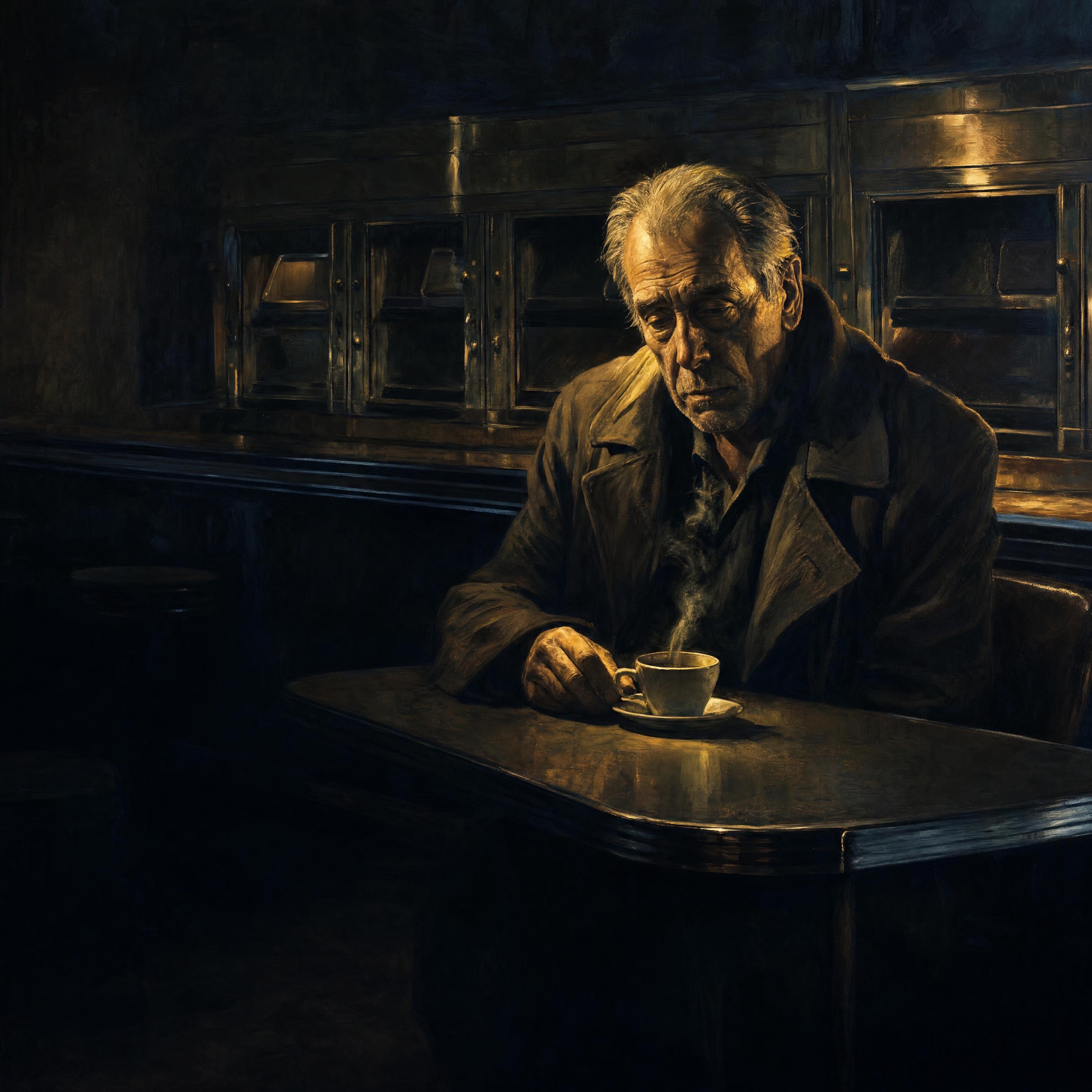
Sit down, Sowell. Your coffee's gone to cold, and you've stood over that table long enough for one night. A man your age ain't got the knees for standing.
You know what I done, Tobin. You've knowed it forty years. So say the number. Whatever it is, I'll owe it. I got nothin' to pay with, but I'll owe it. That's all a man like me's got left to hand across a table — the owing.
The automat ran all night because the city never fully closed its eyes, and at the deepest hour of an August heat the marble held two old men and their two cups of coin-slot coffee. I sat one stool down with the case finished and folded in my pocket. One of them was the wronged party. The other had done the thing. I knew which was which the way you know a wound is old — by how careful the room was around it.
There's no number. There was never going to be a number. I didn't cross this town to collect, Sowell. I come to tell you to put it down. You've carried my boy up out of that cold water every night of your life. Set him on the ground. Nobody's holding the marker. There ain't any marker — there never was.
Then what do I do with it? A man's gotta do somethin' with a thing that big. You can't just... you can't hand a man back forty years and tell him it's his to spend.
You drink your coffee. And you let an old fool buy the both of us the next cup.
I'd spent a whole season learning the price of exactly that — mercy metered out by the ounce, absolution with a fee stamped on the back. I knew every mechanism of what had happened at that table tonight; I could have written the ledger of it in my sleep. But there was no ledger. No fee, no flinch, no hook left to hang a man on. Just one old man setting another one free for nothing, and it landed on me all wrong, like a debt paid in a currency I'd never once seen change hands in this city. I came here to close a case. I couldn't have told you what I'd just watched, or why a free cup of coffee had knocked the floor out from under me.
Segment two · Older Than Money
Sowell rented a room over the flophouse the way a man rents a place to be sick in — one window, one chair, and a smell of other people's bad years soaked into the plaster. He was sitting on the edge of the cot when I came up, folded over his own knees like a coat somebody meant to throw out. I'd brought him the best news he'd had in a decade. He took it like a draft under the door.
Sowell. That marker the flophouse man's been squeezing you on — the debt, the interest, the whole account. It's a forgery. Somebody drew it up out of thin air to bleed the old-timers on this block, and there's paper enough now to put him in front of a judge. So listen to me. You don't owe it. Tomorrow it gets torn in half. You're clear.
Then you tore up the wrong paper.
It's the one that had a man leaning on your throat for money you never borrowed. Most fellas would call that the right paper.
The money was never the debt. You hear me? The number was never what I owed. There's a boy owed a breath he never got to take, down in the cold and the dark, twenty fathoms of it, and no judge you know and no paper you can burn touches one hour of that. So save your good news. I had this coming. All of it. Every day of it. Go tear up something that matters to somebody.
I've spent this whole season with my ear pressed to what people are really paying for, under the number they say out loud. And Sowell had a second account open somewhere — older than any marker, deeper than any water I could name, and he meant to settle it to the last cold hour. I went down the stairs no lighter than I came up. I'd killed his debt. I hadn't touched the thing he actually owed, because I couldn't even read what it was written in.
Segment three · No Ear for It
That's the third time you've told me this one, sunshine, and it gets stranger every lap. An old night-watchman spends his own rent money to save a man he won't explain, and asks you for exactly nothing. Read it back to yourself and tell me which part you think is the trick.
Dale sat across the desk with the afternoon coming through the blinds in long yellow bars, a pencil doing nothing behind her ear. She's the one who says the thing I'm working around out loud, whether I've paid for it or not. I laid the client out for her the way you lay out a hand you can't figure — the watchman, the money he wouldn't keep, the man he wouldn't name.
It's a play, Dale. I just haven't cracked it. Nobody spends himself to the bone on a stranger and walks away holding nothing. There's an angle in there somewhere. There always is. I only have to find where the old man's collecting.
There's your trouble, and it isn't the watchman. It's you. You've spent a whole year putting a price tag on every kindness that came through that door — who paid, who pocketed it, what the vig ran. So now a mercy with no number on it walks in, and your ear tells you it's a swindle, because a swindle is the only shape you've got left that fits. That's not his blind spot, sunshine. It's yours.
Or I've just met enough people to know free is the most expensive word in the language.
Maybe. So here's the only question worth the coffee. The day the real article finally walks in here — the genuine thing, given free, no angle under it, nothing owed either way — what are you going to do when you can't tell it apart from the con? Because on today's showing, you'll price it, and you'll be wrong, and you won't ever know.
She let it sit there in the yellow light like a bill she had no intention of picking up. I told her it was a fine sentiment and no earthly use to a working man, and I filed it in the drawer where I keep the other things she's right about and I don't use. She'd named exactly what the year had cost me, down to the penny. I just couldn't hear it — which was, I suppose, the whole entire point.
Segment four · The Forged Hand
Detective — quit standing in the doorway like the last man at a wake. Flynn, Chronicle. You came in asking about that flophouse lender bleeding the old-timers. I've got a whole morgue drawer that sings his name. Come look.
The Chronicle newsroom at four in the morning sounded like a machine that had forgotten how to stop — typewriters going like hail on a tin roof, and Flynn of the Chronicle in the middle of it, sleeves shoved up, spreading dead men's paper across a desk like a card sharp who'd finally caught the deck marked.
Twelve markers. Twelve different old men down in the flophouse blocks. Every signature a hair too neat, and every one of them dated a day the man was drying out in the charity ward or sleeping it off in the tank. Same hand forged all twelve. Your old man, Sowell — he's the thirteenth.
So the debt was never his. None of them were real.
Not a nickel of it. He wrote the paper himself, then bled them monthly on the lie. And here's the sweet part — the forgery's his own noose. Hand the originals to the D.A. and the fraud proves itself. He's finished by morning. It's already moving on the wire.
For once the arithmetic came out clean. A man who forged debt onto the ruined would go down for the ink he spilled, and a dozen old-timers would wake up owing nobody. I'd walked in to close a case, and the case had closed itself. I reached for my hat, which is always when this city decides you've heard too little.
One thing before you go — I pulled the old crew manifests while I was digging. Habit. Your two old men, the watchman and Sowell? Same ship, twenty-odd years back. Same crew, the season a hold went under off the point. One of them lost a boy in that water. Thought you'd want to know whose.
He gave me the name off the manifest, and it sat in my chest like a stone dropped down a well I hadn't known was there. My client was the father. The man I was saving from a false debt had been on the crew the night the father's son drowned. The case was won and paid for, and only then did the right question finally start to form: why would a man spend the last of himself to save his son's drowning-mate?
Segment five · No Name to Ask For
The far end of the pier is where the city keeps the men it's finished using. A lantern, a folding chair, a thermos gone cold, and an old watchman standing his post over water nobody was going to steal. He'd sent for me by a description instead of a name, which in my trade is either caution or trouble, and out here at that hour it's usually both.
They tell me down the waterfront there's a man works his door for nothing. Takes the ones that can't pay. I never got a name off the glass — there isn't one to get. Just the standing of the fella who does it for free. Figured that was you.
Depends who's asking. Out here, this hour, a man with no name for me usually wants something he can't say in daylight. You've got a name, at least.
Tobin. Night watchman, this pier, twenty years. There's a man up in the flophouse blocks — Sowell. Somebody's hung a debt on him he never signed for, and it's grinding him into the boards. I want him off it. That's the whole of what I came to buy.
I'd spent the whole season learning the going rate on mercy — who paid, who collected, and the second party always waiting in the wings with his hand out. So I did what the season had taught me. I looked for the string on the other end of this one.
A man spends good money springing another man off a debt, there's usually a wire running back to his own pocket. What's Sowell to you, Tobin?
Nothing you'd write in a ledger. Save him the marker. Leave the rest where it lies.
He wouldn't budge, and a man who won't name his reason is, in my experience, a man loading a lever he means to pull later. I took the job to find the other end of it. It never once crossed my mind that there might not be one — that a man could stand at the end of a pier and buy nothing at all, and pay for it out of himself.
Segment six · The Hatch
The harbor at first light goes the color of an old wound, and Tobin stood in it the way some men stand at a graveside — done grieving, just keeping the ground company. I'd traced the whole night backward looking for who was paying, and I'd come out the wrong end, at the beginning, with nothing in my hands but an answer I didn't want.
You went looking for who's paying. I can see it on you. Save your legs — nobody is. Sit down. It's near light, and I've carried this alone about long enough.
Twenty years you've been carrying a debt of your own. Sowell was on your boy's crew the night the hold went under.
There was a hold took water off the point. My son was down in it. Sowell was at the hatch — one bar, one pull, and my boy comes up into the air. He didn't throw it. He froze, and the water came up over my son an arm's length from the light. Sowell's not a wicked man, detective. He was a frightened one. That's worse to forgive and easier, both.
And you spent the last of yourself keeping the man who let him drown off a debt that was never even his.
He's been going down in that hold longer than my boy took to. Twenty years, every night, and I watched him do it. I'm too old to keep watching a man get crushed for a thing he can't undo. Nobody's paying me. There's nothing owed and nothing to collect. Let him die out from under it, not in it. That's all.
I'd spent a whole winter pricing forgiveness — who sold it, who bought it, what it cost and who got stuck with the bill. And here, at the end of a pier at dawn, was the one kind the whole racket couldn't counterfeit: a father spending his last strength to forgive the man who'd cost him his son, for no reason the city could name and no dollar it could trace. I'd opened on it a full night ago and couldn't hear it, because I'd forgotten a thing given for free even sounds like. Nobody paid. It was the only forgiveness in this town I'll ever be sure was real, and it didn't cost a nickel.