



Vouched
A woman at the back who never applauds is gone before the handshake, and Cole's thanks land a half-beat too smooth, a wrongness the detective can't place under all that warmth.
Pinned to the Corkboard and will not be contradicted by a later case.
Closed for good. The dead stay dead, and the canon is append-only.
Segment one · One Clean Morning
I want to thank the commission for putting my name back on the board. A man loses his standing on these docks, he loses everything a man is. You good people gave me back my trade this morning, and my place among honest men. I'll spend what years I've got left earning it.
That was Cole at the podium, hat in his hands, his voice soft as a Sunday. Ten years back the harbor took a dockhand and the record called it an accident, and it cost Cole his working papers all the same. This warm morning in June the commission gave them back, restored his good name to the register, and called the old business closed. I sat in the second row, because my word was part of why they could.
The clerk read the file into the record before they'd let Cole speak. Character attested, it said, by the licensed man who looked into him. Then the naming line, and where a name should sit there was a blank the clerk passed over like a missing stair. My word was on the harbor's paper this morning with nobody's name underneath to hold it up. Known. Not named. That was how I'd wanted it, once.
Flynn, Chronicle. Some morning, isn't it? Whole commission stood up for a man they blacklisted a decade back. You catch that line the clerk read? 'The licensed man who looked into him.' That's you sitting there, isn't it? The paper would love a name to pin the good deed to.
There's no name, Flynn. Print it the way the clerk read it. A blank.
A board vote this clean, somebody sanded every splinter off it before the gavel dropped. The reinstatement, the file, the whole warm room. That's the part I can't run. Yet.
Detective. I owe you the most of anybody in this hall. You looked at an old man nobody on these docks would look at, and you found somebody worth vouching for. I won't forget it. I mean that with everything I've got left.
He said it warm, and he meant it, and it landed a half-beat too smooth, like a line worked over in a mirror until the seams stop showing. Somewhere a side door let in the smell of low tide off the slack water. A woman at the back of the hall had not clapped once the whole morning, and by the time Cole put out his hand for mine, she was already gone. I couldn't place the wrongness under all that warmth, so I told myself it was nothing. The whole room was smiling. I hadn't yet learned to be afraid of a morning that clean.
Segment two · The Name She Said
An hour before the applause, there was a room behind the hall where the good deeds get their signatures. I stood at a side table with a borrowed fountain pen and a letter of good character, and I put my name to the bottom of it — the last clean line on a page already full of them. I was reaching for my hat when she came through the crowd. A woman in a gray coat, grief worn into her the way you wear a coat two winters too long.
Mister — please. You're the one who signed for him, aren't you? You have to listen, it'll only take a second of your time. You don't know what that man is. My brother knew. My brother knew what really happened down on those docks, and now — please, just hear me out.
Ma'am, they're about to start in there. If you've got a complaint about a clemency, that's the D.A.'s office, down the hall. I'm only here to put a name to a letter and go home.
Danny. Danny Foss — that's his name, write it down, remember it. Danny Foss. Just ask somebody where my brother is this morning. Ask anybody in that room, and watch what their face does when you say it.
Two men in committee ribbons had her by the elbows before she finished, polite as pallbearers, steering her toward the door like she was the one thing out of place in a perfect morning.
His name is Danny Foss! You had the pen right there in your hand — you had the pen — !
The door took her voice with it. I had a name now — Danny Foss — and a pen already capped in my pocket, and a ceremony starting on the other side of the wall. A name is a thread, and I've never met one I didn't pull. But that morning I had somewhere to be. So I filed the name where a man files the things he means never to think of again, and I went in to watch a good man be forgiven. God help me, I'd forgotten her by the time I found my seat.
Segment three · Made to Order
The night before Cole's name went clean, I found Flynn of the Chronicle down in the back shop, where the presses were warming and the whole place smelled of ink and hot lead and tomorrow's edition. He had the Sunday run spread across a stone table, and he wore the grin he saves for when he's found the room where a man's reputation gets made to order.
Look at this. Full page, Sunday, above the fold — the whole hard-luck life of Cole, the dock man who turned it around. Sweet, isn't it? You know what a page like that costs to plant? Somebody bought Cole a brand-new past, detective. The profile, the tender quotes, three upstanding neighbors who suddenly remember him fondly, a records board that found an open morning on a full calendar. This desk launders a man's name for a fee. I've watched it before. I just never watched it run this fast.
Maybe the man's just clean, Flynn. People turn it around. It happens about once a decade — maybe this is the once.
Turning it around doesn't buy a Sunday page and hurry a board along in the same week. Somebody wanted Cole printed spotless, wanted it loud, wanted it quick, and had the cash for all three. But here's the piece that's got me chewing my pencil down to the tin.
Go on. You've been itching to say it since I walked in.
Every plank in this thing has a price I can trace — the page, the neighbors, the board, all bought, all paid. Every one but yours. Your word. The licensed man who vouched for him. That's the only thing in the whole business that still looks given instead of bought. Free. Clean. Which makes it the one brick nobody can follow the money on — and the only one holding the rest of it up straight.
I told him he saw a racket in every act of decency, and I believed it. I still figured I was the honest part of a bought morning — the one square inch of it nobody had paid for. Flynn only tapped the page and put the question to me plain: who profits when a dock man goes clean overnight? I left him to his presses and walked home feeling as square as I ever had. The question stayed behind in that greasy room, patient, unanswered — waiting the way a thing waits when it already knows the answer is you.
Segment four · Low Water
The fish pier at low water smells like everything the harbor forgot to swallow. She was waiting for me out at the end of it, past the last lamp, a small woman standing very straight against a railing that had rotted through years ago. She had a way of holding still that looked like she was bracing for a blow that hadn't come yet.
You're the investigator. The one they say Cole wants to speak for him. I need a minute before you do. My name doesn't matter — but my brother's does. Danny. Danny Foss. He worked these docks before Cole ever went clean.
I know the name Foss. What about Danny?
He's gone. Four days now, no word, and Danny always sends word. He's the only one left who was down here the night that other dockhand died — the one they wrote up as an accident. Danny always said it was no accident. He'd swear to it. And now, the same week the whole city lines up to forgive Cole, my brother just... isn't anywhere.
Men skip town, ma'am. Especially men with old scores and no money. It isn't proof of anything but a bus ticket.
He wouldn't leave me. Please. Don't put your name on that man until you find my brother. That's all I'm asking. Just don't be the one who makes it clean.
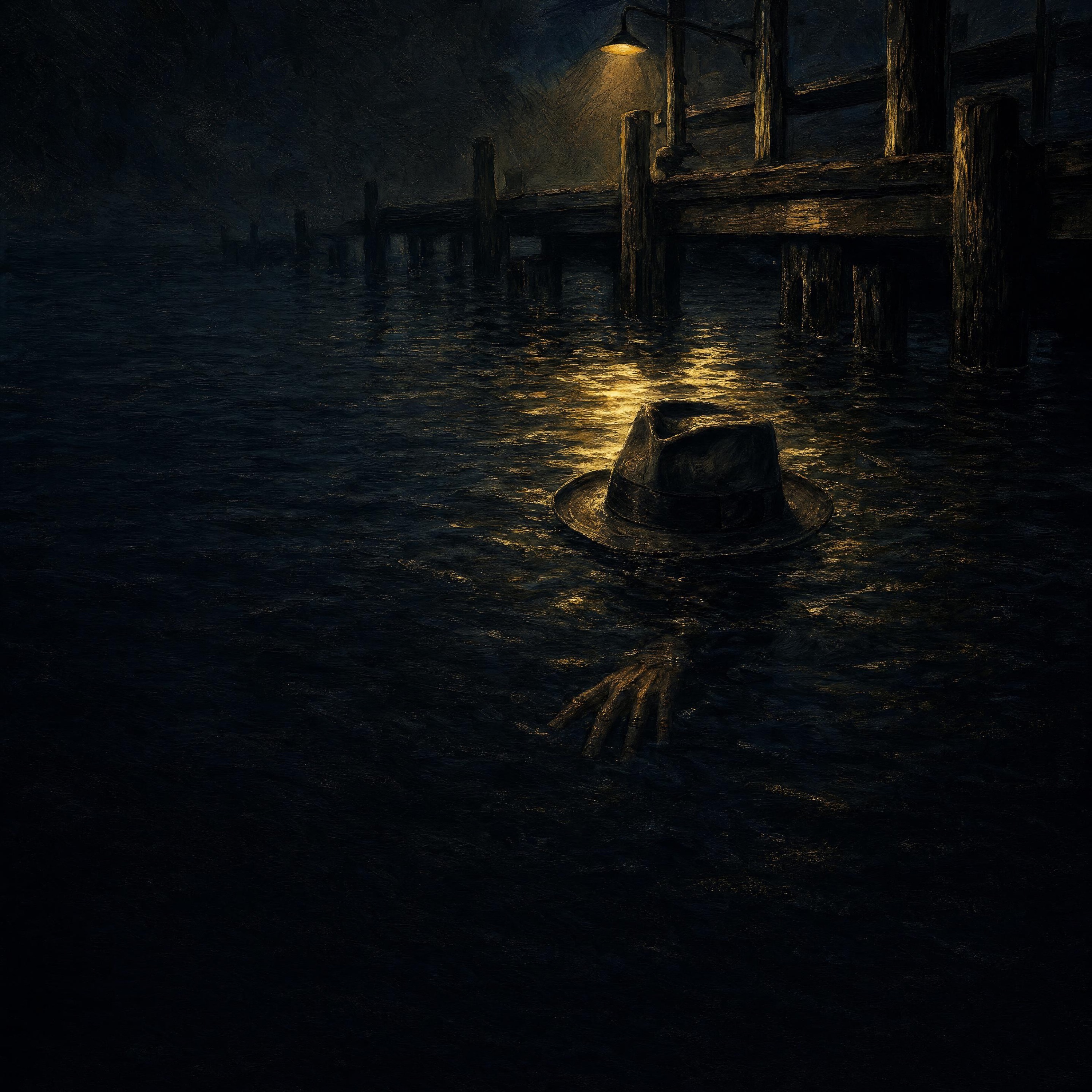
I told her I'd look into it. I told myself I meant it. But a reformed man had a signed record and a city ready to cheer, and all she had was a missing brother and a bad feeling, and I had already decided which of those two things weighed more. The water was dead low, sucked back off the mud, and under the black pilings something pale turned once with the slack and went still. I looked at the horizon instead. I was already good at not seeing it.
Segment five · The Thing He Said
Earlier that same night, before dawn had any ideas, Cole sat me down in a shack at the end of the pier with a lamp between us and a pot of coffee he'd made himself. He was a big man gone gentle, soft-spoken, the kind of quiet that people mistake for peace. He poured for me first. That's the part I keep coming back to. He poured for me first.
Thank you for coming out here so late. I know what you are — the licensed man, the one whose word the board will actually believe. I'm not asking you to lie for me. I'm asking you to look at who I am now and just say what you see. That's all. A man can change, detective. I have to believe a man can change.
People say that to me a lot, Cole. Usually the ones who've got the most to be forgiven for.
That's fair. That's fair. I did a hard thing once, years back, down on these boards. I've made my peace with it. And I've made certain the old story stays drowned, so it can't reach up and pull anybody else down with it. You understand. Some things you have to put where the water keeps them, so they stay quiet, and the rest of us can go on.
A man burying his past. Sure. I've buried a few of my own.
Then we understand each other. Say the word for me tomorrow. It'll be the truth by the time you say it.
Stays drowned. I heard it the way you hear a hymn, all shape and no meaning, and I set my cup down and let it go by. His hands were folded on the table, big and clean and scrubbed pink, and coiled on a nail by the door was a length of rope still dark and heavy with water, though it hadn't rained in a week. Run the night backward and that sentence comes apart in your hands like wet paper. Some things you put where the water keeps them. He wasn't speaking in figures. He never was.
Segment six · What I Put My Name To
First light came up gray over the harbor, the earliest hour, before the city woke to go and forgive a man. The sister was already out at the end of the pier where I'd left her days ago, in the same coat, in the same straight-backed stillness, looking down at water gone flat and low as a held breath. And standing there, watching her watch the tide, I finally saw the whole shape of it, all at once, the way you see the whole street the instant the lightning quits.
Danny Foss went into this water the night before the city pardoned the man who put him here. Not skipped town. Not run off. Drowned quiet at low tide so the forgiveness would come off spotless — no last witness left to call the old killing what it was. And the wall that sealed it, the one clean brick in the whole bought thing, was my word. Cole didn't need to buy me. He just needed me to not look down.
You said it. I heard them read it out — the licensed man who vouched. I stood in the back of that hall and I heard your words hold the door shut on my brother.
I know. I know what I put my name to. There's nothing under here I can bring up, and there's not a soul in this city who'll look — because I already told them there was nothing to find.
The harbor keeps what it takes. Some things go in off this pier and the water just doesn't give them back. I'll stand here anyway. Somebody should stand where he won't wash up.
By noon they'd hang a medal of good citizenship on Cole and the flashbulbs would love him. A killer, pardoned and beloved. A sister, silent on a rotten pier. A brother down under the tide with my signature for a headstone. I don't get to fix this one. I don't even get the clean weary lie of a lesson learned. I just get to know exactly what my word is worth now, and to stand next to a woman who already knew, and to wait for a tide that isn't going to give anything back.