



Play This When I'm Gone
The master of ceremonies announces the dead man left a testament in his own voice to be played tonight, and the detective feels the weight of the second cylinder, the true one, against his ribs.
Pinned to the Corkboard and will not be contradicted by a later case.
Closed for good. The dead stay dead, and the canon is append-only.
Segment one · A Hall Full of Grace
The hall was warm the way a June night gets warm, close and full, and every folding chair held a mourner who'd come downtown to forgive a dead man. They'd draped the lectern in black crepe and hung his photograph above it, and the whole room leaned toward that picture like flowers leaning at a window. A man who drowned in his own harbor, and a thousand people risen to their feet to love him for it.
Look at them. On their feet already, and he hasn't said a word yet.
The woman beside me hadn't come to mourn. An hour before they opened the doors she'd found me on the steps and pressed a dictaphone cylinder into my hand like it was something hot, then folded my fingers shut over it.
That one's the only one that tells the truth, mister. When they've had their fill of the other, you play it.
Then a man in a good black suit stepped to the lectern and hushed the room, and told us the great man had not left us empty-handed. He'd left words. His own voice, set down in wax before the water took him, saved for this night, to be played.
The room drew one breath, the way a congregation does before a hymn. And against my ribs, in the pocket of my coat, the second cylinder sat there with a weight it had no honest right to have. The true one. The one he never built this room to hear.
Segment two · Two Cylinders, One End
You want to know who they're weeping over out there? Come off the floor a minute. I'll tell you the part the papers wouldn't.
She steered me into an anteroom that smelled of cold coffee and funeral lilies, and there, with the crowd shut behind a door, the tired woman finally said it out loud.
He built the mission on Cannery Street. The relief line that fed half the waterfront. Every dime of it he took off men who trusted him, before he learned that charity buys a clean name cheaper than a lawyer ever could.
And the harbor didn't take him by accident, mister. You'll never read that. What you'll read is a tragic misfortune, and a good man gone too soon.
A few weeks back I'd carried a certainty out of a cold little chapel: that absolution, once it's bought and paid for, is a wall no proof will ever climb. I'd watched that wall hold. Standing in the smell of those lilies, I felt the same wall go up around a dead man, and I understood the thing she couldn't. They hadn't come to weigh him. They'd come to forgive him.
Play what's on that wax and they'll have to know. All of it, in his own voice. Let's see them keep standing then.
She thought the confession was a crack in his sainthood. It wasn't. A room that comes to forgive will forgive anything it hears a man admit, and love him harder for the nerve of admitting it. Both cylinders ran to the same door. The true one was just the last coat of lacquer, and she'd handed me the brush.
Segment three · In His Own Voice
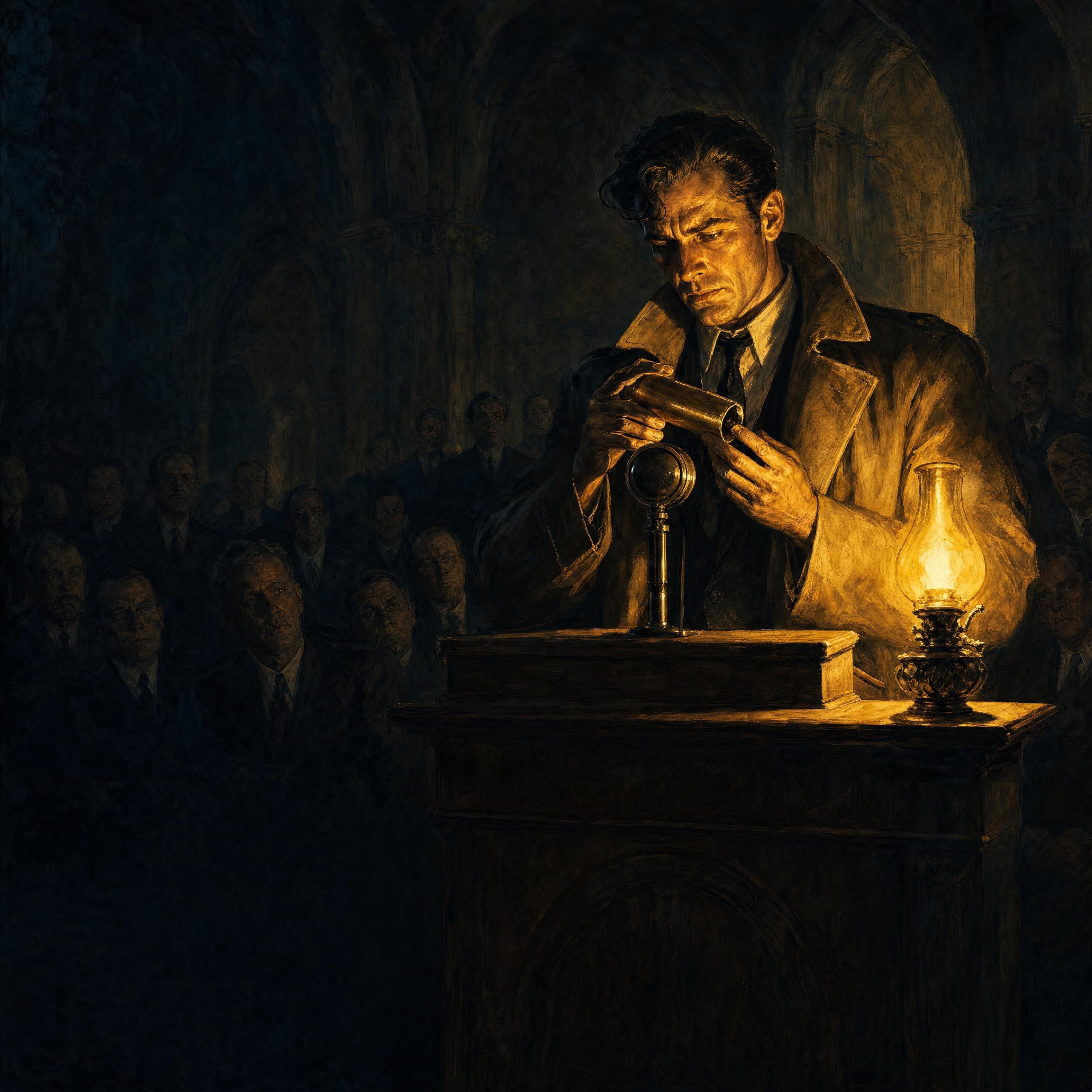
The man in the good suit set the sanctioned cylinder on the machine, stepped back, and folded his hands. And the dead man's voice came up out of the horn, warm as a hand laid on your shoulder in the dark.
My friends. If you're hearing this, then I've gone on ahead, and I'm not afraid, because I leave you the only thing worth leaving. The work. Feed them. Shelter them. Ask no man his name at the door. That's all I ever tried to do down here.
A sigh went through the hall, soft and grateful, a thousand people forgiving him in advance. And I found I was already on my feet, walking the center aisle toward the machine the way you walk in a dream you know you can't stop.
I lifted the sainted cylinder off the spindle and set the other one down in its place, and before the good black suit could get a hand on my arm, I dropped the needle.
So. If somebody's playing this, I'm past caring who's in the room. The mission, the relief line, all of it, I raised it on money I took off better men than me, and I let one of them hang for the taking. And there was a girl, twenty years back. I let this whole town believe it was the tide that carried her out. It wasn't. Forgive me this. Forgive me all of it, and you make me clean.
The last word went out into the horn and died there, and I stood in that silence and waited for the room to turn on him. The silence held. And then, somewhere in the back, a woman began very softly to weep, and it wasn't horror in it. It was grace.
Segment four · Nothing in Her Hands
By the time they'd wrung the last hymn out of him the hall stood empty, chairs shoved at angles, the black crepe gone gray under the worklights. They hadn't recoiled. They'd rowed him the rest of the way to sainthood on the strength of his own worst hour, because a man brave enough to name his sins is twice the saint. I stood by the dead machine, the only devil left in the room.
You did the hard thing, mister. You played it. And it didn't matter. Not one soul in that room loves him a hair less.
She had it right. Out in the lobby a man from the committee was already telling the reporters what kind of jackal breaks into a funeral to spit on a good man's grave. He didn't have my name. Nobody in this town ever does. But he had my face, and a face would do. And standing there I finally understood the whole shape of it: the dead man had left that cylinder to be found, and played, and swallowed. It was the last thing he ever needed from a stranger, someone honest enough to drop the needle. I'd handed it to him for free.
I thought if they heard it out of his own mouth, it would count. That's all I ever wanted. For it to count for something.
So did I.