




What the Poor Box Kept
The books already read too clean, and the easy answer for the shortage already wears a name — a dead man's.
This case aired inside one episode with Case 051 — Known by Ear. Tuning in here drops the needle at the cold open and runs on into the second half at 13:03.
In Apple, Spotify or Amazon the episode is the whole double feature — there is no separate file for this case.
Pinned to the Corkboard and will not be contradicted by a later case.
Closed for good. The dead stay dead, and the canon is append-only.
Segment one · Counting to the Penny
The diocese wanted its charity counted to the penny, and they wanted a man who'd hand them the number and swallow the story that came with it. An offstage monsignor signed the check. I took the job the way you take any job in a dry spell — with both hands and no questions. But I'll give you the ending before the beginning, because the ending was already sitting in that tin when I walked in: the books were going to come up short, and the short was going to wear a dead man's name. I just hadn't met the man who'd fitted it there yet.
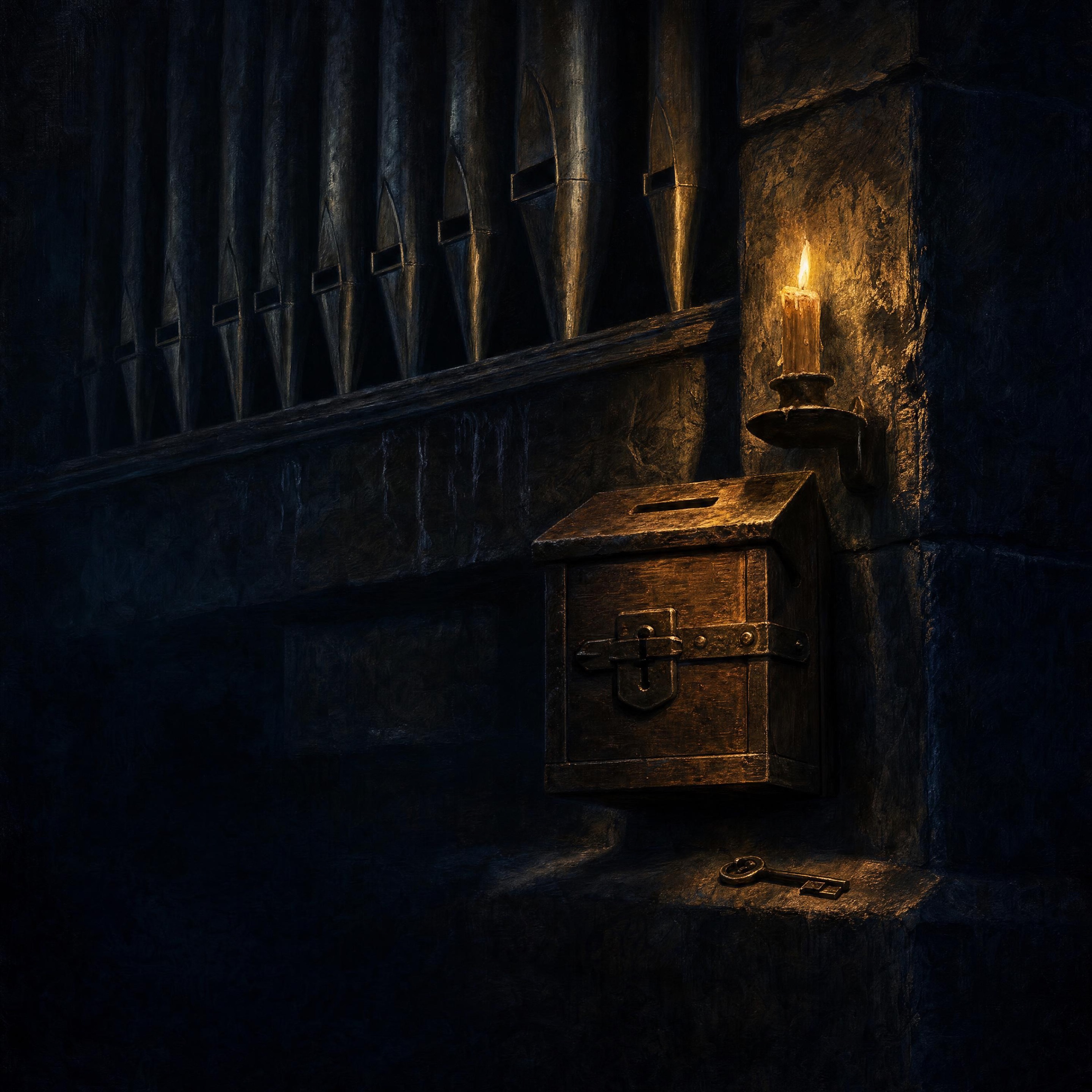
The sexton met me at the side door with a ring of keys and a face like a man apologizing for weather he didn't make. He walked me to the poor box — a dented tin bolted beside the door, the coin slot worn bright where thirty winters of thumbs had pushed nickels through it. He put his hand on it soft, the way you'd touch something sleeping.
Mind that bottom hinge, mister, it bites. There she is — the poor box. Folks give what they can, and these days that ain't much, but it's steady. I empty her Sundays, count her at the table, mark it in the book. Same as Deacon Pell taught me, God rest him. He kept the ledgers, you understand. Careful hand. Careful man.
Careful men make my job short. When's the last count that came out square?
Ah, that's the sorrow of it, sir. The Deacon took poorly around Candlemas — couldn't hardly hold the pen at the end. His numbers went soft the way a man goes soft when he's dying. Nobody's fault. He let a few things slip, at the last. You'll see it in his hand, if you look close. It's all there in his hand.
He said it gentle, the way you lay flowers. And that was the trouble. I'd been in the room four minutes and the books already read too clean, the shortage already had a face, and the face belonged to a man who couldn't argue back. In this city the dead make the finest defendants. They never take the stand, and they never once change their story.
Segment two · A Careful Man's Trail
The rectory hadn't been warm since the old pastor died in it. One bulb over one table, a stack of ledgers squared to the edge, and the sexton pouring me the deacon's last months the way a man pours tea for the bereaved — careful not to spill, careful I got the good cup.
Here's Advent, mister — see how firm the figures sit? A steady man's hand. Now here's Lent. Watch the writin' shrink on you. That's the sickness in it. Deacon Pell wrote smaller as he got smaller, poor soul. This gap here, and this one after — that ain't thievin', God forbid the word. That's a tired man losin' his count.
You've got it all lined up already. Advent to Lent. Every soft spot marked before I asked.
Well — a body wants to be helpful, don't he. My wife says I fret too much over other men's numbers. But the diocese men come Friday, sir, and somebody's got to have the answer ready when they do. Better a kind answer about a dead man than a hard question about a living one. We've rooms over the laundry, the note comes due whether these books do or not.
Every hole in that ledger he'd already packed with the same soft plaster, and every patch had the deacon's name pressed into it. He wasn't confessing. He was rehearsing. And a rehearsed grief keeps a rhythm real grief never learns — I've heard enough of the genuine article at enough kitchen tables to hear where the beat sits wrong.
So I nodded, and I wrote down nothing, and I let him lead me hole to hole like a docent in an empty museum. A man who steers you that gentle is steering you past something. I just hadn't found the wall he kept turning me away from. Not yet.
Segment three · A Dead Man's Tuesday
Flynn of the Chronicle kept a desk like a crime scene and a memory like a card catalogue. When I needed a date nailed down cold, I didn't go to the church. I went to the newsman who'd already set the obituary in type.
Well, if it isn't the shamus. Pull up a crate, I'm making your little parish into Sunday copy — 'Dead Deacon's Last Gift Feeds the Pier.' Pell was a saint with a pencil, the readers'll weep right into their oatmeal. Now what do you need, because you didn't climb three flights to admire my prose.
Dates, Flynn. Two of them. When Deacon Pell took to his bed, and when they buried him. Straight from the paper, not the pulpit.
Pell? Easy money. Took to his bed second week of Lent — I ran the item, 'ailing after long service.' Died the morning of the twenty-ninth of March. Buried the first of April. I made the fool's-day crack in the copy and my editor cut it for taste. Why? You've got that arithmetic look. You always look like a man carrying change he can't spend.
I had a photograph folded in my pocket — the poor-box page, the one the sexton had walked me past a shade too smooth. One line on it, a Tuesday's take, entered in that same careful hand. Dated the sixth of April. Six days after they'd shoveled the last dirt on Deacon Pell.
You've gone quiet, and quiet out of you is a headline with the ink still wet. Come on. Give me the angle.
I gave him a smile and not one word more, because the arithmetic had already spoken and it only knew how to say one thing. A dead man can't post a Tuesday. But somebody had, in a hand that matched the deacon's like a forger's love letter — and only one man still breathing carried a key to that tin. I'd come in hunting a bookkeeping error. I walked out knowing a living hand had signed a dead man's name, and a frame stitched that neat is never once an accident.
Segment four · What the Freeze Took
The sexton's kitchen ran cold even with the kettle on, the kind of cold that lives in the walls of a house near water and never quite moves out. Emmett sat with his hands flat on the oilcloth like a man bracing a table that wasn't shaking. I laid the ledger page down where the lamp could reach it, and I let the date sit there and be the loudest thing in the room.
Take your hat off in my kitchen, mister, or take your questions back out to the rain. Emmett, don't touch it — don't give him the satisfaction. Whatever's crooked in those numbers, it's Deacon Pell's hand that kept them, and Pell's in the ground a month now. A dead man doesn't feel the weight of a bad column. We're the ones still here paying rent on a room we can't heat.
You're Nora, then. I'm not arguing the deacon's hand, Mrs. — I'm arguing his calendar. This entry's dated the sixth of April. They put Pell in the ground on the first. Dead men keep still. They don't reach back into a poor box and move a week's worth of coin.
Then the pen slipped. A tired man writes a wrong number, it happens in every parish in this city. You'd bury my husband over a smudged date? Thirty years he's swept that church and trimmed those wicks for nothing but a cot and a landlord who waits. Let it fall on Pell. It costs the dead nothing at all, and it's the only thing standing between us and the street.
Enough, Nora. Enough now. It isn't Pell's, mister. It was never his. It was mine, and it's old — older than that dead man's whole time in the parish. The winter the harbor froze solid. No boats, no work, no coal, and the boy coughing through the nights. I went to the box for it. A few coins. Then more than a few. I always swore I'd square it, and I never once had the square to give.
The old pastor caught me at the tin one night I thought the church was empty. And he didn't call the precinct, and he didn't wire the diocese, and he never set a single word of it in any book of his. He just took my head in his two hands, and he forgave me — asked me nothing, made me swear to nothing, and never spoke of it again from that night to the morning we buried him. That hole you're holding, mister — that's it. Twenty years old. It only came up now because there's finally men coming to count.
So there it was, plain on the oilcloth between the salt and a cold cup of tea. A forgiveness given away for free, in a dark empty church, off every book that was ever ruled — and the only record it ever left in this whole world was the shortage under my thumb, come due two decades late and dressed up as a theft. Name the living man and I'd be handing an audit the one figure it could never total: that this debt was settled long ago, the only way that kind of debt ever settles, by a tired old priest deciding alone in the dark not to collect.
The pastor forgave him for nothing, asked for nothing, wrote down nothing. And here I stood in a freezing kitchen with the only proof that mercy had ever drawn breath — a hole in a poor box. Close the hole and I'd wipe out the sin. Keep it honest and I'd wipe out the grace. The room didn't come with a third door, and I'd already caught myself reaching for the handle of one that wasn't there.
Segment five · The Standing Balance
The diocese got its figure Friday. The books came out even — a tired old bookkeeper's slack last winter, a hole the dead can carry without ever once talking back. I signed the page and shook two soft hands and walked out into the rain, and every honest number on that sheet was a lie I put there myself. Dale had the coffee poured before I got my hat off. She had the look, too, the one for the nights she's finished the arithmetic ahead of me.
There he is. The parish auditor, home from the front. So did the poor box come out square, sunshine, or did you square it? Because those aren't the same job, and I've watched you long enough to know which one they actually hired.
It came out square. Deacon Pell kept a loose pen his last months and the count drifted. The diocese went home happy. No arrests, no ruin, no headline. A quiet week.
Deacon Pell. The dead one. Very tidy, a bookkeeper who can't stand up and object. You didn't audit that box, you picked a name to hang the hole on and made sure it belonged to a man past caring. The one still breathing keeps his key and his supper and his sleep. And you filed it clean because somewhere back there a shortage started as a kindness nobody ever charged for — and that's the part the city can't process. It's got a column for everything except a thing with no invoice.
I didn't argue it. I opened the bottom drawer instead — the one that has never once held a bottle — and laid a single sheet flat on the stack already there, the true pages, the ones no diocese man will ever thumb. The drawer took the new weight without a word and closed heavier than it came open.
That's the trouble with a debt no one wrote down. It doesn't clear. It just moves. It was the church's to carry, then a dead man's — and tonight you slid it into a drawer with your name on the desk. No entry, no witness, nothing to point a diocese at. Congratulations. You're the only place it's on the books now, and you don't get to close yourself out.