



The Marker No One Pays
Brogan asks him to hold one old man's gate call before the morning shape — and holding it means walking into the machine that finally has his face.
Pinned to the Corkboard and will not be contradicted by a later case.
Closed for good. The dead stay dead, and the canon is append-only.
Segment one · The Old Beat
The rain had been coming down since midnight — the kind that doesn't fall so much as settle, like the city easing into a chair it can't get out of. Paddy Brogan filled my doorway the way bad news fills a telegram, and Brogan hadn't carried a badge in years. When a man who's off the force comes to you at two in the morning, he isn't there to reminisce.
Don't get up, shamus. I still know the way in. Pour me something that isn't coffee — I've had a bellyful of coffee and a bellyful of bein' polite.
It's a long walk in the rain for a drink you could've had at home, Paddy. You came for something you can't ask a cop. Which means you came to ask me.
There's a man down on the North pier. Corrigan. Vinnie Corrigan. I walked that dock twenty years, and the winter I made lieutenant he hauled two of my rookies out of the black water with his own two hands. I swore to him that day — anything, any morning he wanted it. He never once called the marker in.
And now you're calling it in for him.
His name's comin' off the morning list. The hall's got a new way of decidin' who eats down there, and Vinnie's old, and old men don't get the call anymore. I want you to see that it holds. One name. One dawn. That's all I'm askin'.
You've still got friends in a blue coat, Paddy. Why me?
Because the friends I've got won't go near that gate, and the ones who would, I wouldn't trust to mind my hat. You, I trust. God alone knows why.
He set the favor on my desk like a man laying down a card he'd held too long, and he left without ever doing the arithmetic on what it'd cost to stand at that gate and make a name stick. Brogan never did the sums out loud — that was always my job. There was a night, years back, I'd sent a quiet word across town to keep that stubborn badge breathing, and he'd walked out of the room believing he'd done it on his own two legs. I let him keep that. But holding a call at the pier meant walking into the machine that ran it. And the machine, these days, finally had my face.
Segment two · The Gate at Dawn
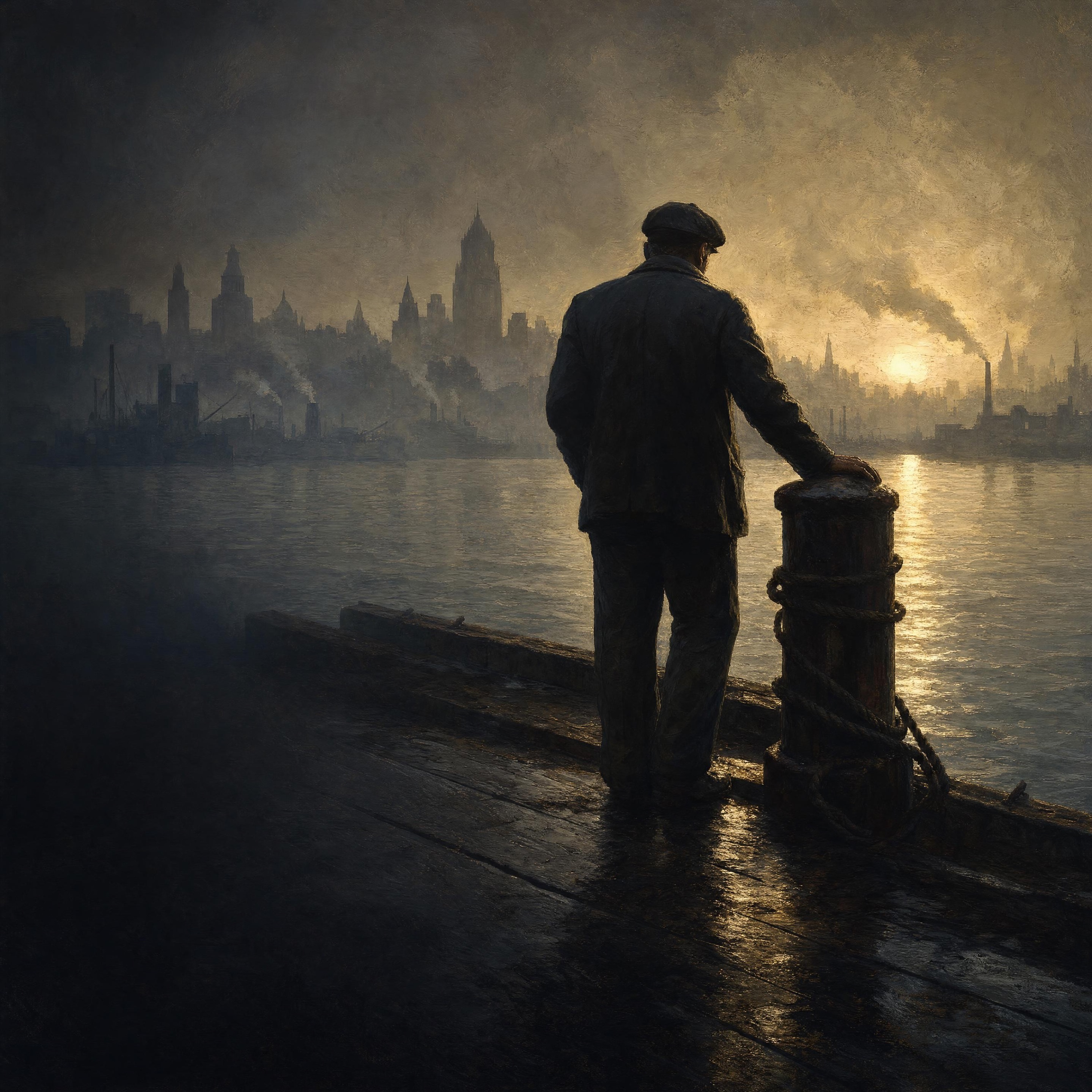
Dawn at the North pier gate isn't dawn. It's a gray rumor over the water, and out in the dark the ice was breaking up with a sound like a door nobody opened. Forty men stood in the cold with their collars up, breath hanging in front of their faces, waiting on a clipboard to say their names out loud. A family eats that week or it doesn't, and the whole difference is one word from a man holding a list.
A young woman stood off from the men — close enough to hear the call, far enough to keep her pride out of it. She had Corrigan's jaw and none of his patience. When she looked at me she already knew who'd sent me.
You're the one Brogan sent. Don't stand where they can see you talking to me, mister — a stranger asking after my father's name doesn't help him. Nothing helps him this morning. I'm Kate. Kate Corrigan. Say it soft or don't say it.
I came to see the man's name stays where it belongs, Miss Corrigan. That's all.
You want to know what it means when they skip him? No work. No work means no envelope come Friday. No envelope, my mother measures the flour twice and my brother goes to bed hungry so the small ones don't notice. That's what a name is down here. It's supper. Don't let anybody dress it up finer than that.
Then we'll keep it where it belongs.
You don't understand how it holds. His place at that gate was never his. It rides on paper — my father carries a marker for another man, a thing owed from years back, and that's the only reason the list ever finds his name at all. Every man standing here holds somebody's paper. That's the whole city, mister, top to bottom.
And now there's somebody who wants that marker called in. Once it's called, my father's got nothing left to stand on. No favor, no oath, no name. Just the cold and the water.
She said it flat, the way you'd read off a weather report, and that was the worst of it. I'd come down to the pier thinking I was here to protect one honest man's name. Turned out the name was borrowed — like everything else in Calloway Bay — and somebody uptown had just decided it was time to collect.
Segment three · He Won't Sell
The harbor bar at the foot of the pier was three stools and a bottle that had outlived its own label. Brogan was there before me, both hands around a coffee he wasn't drinking, looking older than the room and the room looked plenty old. I laid out what I'd carried up from the gate. He didn't much care for the shape of it.
So it's a squeeze. Course it's a squeeze. Tell me the rest of it, shamus — the part you came in here wearin' on your face.
They gave Corrigan a way out, Paddy. Two mornings ago. Told him plain — hand over three names off his own gang, men who've been palming cargo off the night boats, and his call stays good clear through the winter. All he has to do is talk.
And what did Vinnie say to that?
He told them where to walk. Hungry, with his girl at home counting the flour, and he sent them off empty. Wouldn't give up one man standing beside him. Not for supper. Not for the whole winter.
That's Vinnie. Always was. Twenty years I've watched better men than the two of us sell whatever'd fetch a dollar — a partner, a badge, their own good name for one warm room. Not him. That's why I swore to him, detective, and not the other way round. A man like that, you don't let the water have him.
He won't save himself, Paddy. He had the door open and he shut it.
No. Never could. So somebody's got to do the low thing for him, on account of he won't do it for himself. I'd go. But there's not a door in this town opens for me anymore.
In a city where every last man sold something, old Corrigan had sat down in the cold and refused — the one clean thing I'd seen all winter, and it had left him with nothing under his feet. There was exactly one road left to keep his call, and it ran through the only hand that still moved that gate. I'd spent twenty years staying clear of Pauly Marchetti's parlor. Come morning, I was going to have to go and knock.
Segment four · Everybody's Paper
The Blue Room after closing was all velvet and no music, chairs stacked up on the tables like the place had knelt down to pray. Pauly Marchetti didn't run the docks with a gun anymore. He ran them with a fountain pen and a ledger, and that was the worse of the two.
Sit down, pal. You come all this way for one old man's name on a list? It stays. There — done. Costs me nothin' to leave it there. See, I'm a reasonable man.
Nothing. A man's week, his family's supper, and it costs you nothing. That's a new kind of generous, Pauly. The old kind came with a river attached.
Generous, no. You still think it works the old way — I lean, you fold, somebody takes a swim. That's tired. That's for young men who need to be feared. Me, I got a book now. Everybody down at that gate holds somebody's paper. The kid holds his foreman's marker. The foreman holds mine.
And the name at the top of that book of yours?
Now that's a disrespectful question. But I'll give it to you for free, on the house. There ain't one. You go up far enough, the paper just keeps movin' — I hold a marker for a fella you never heard of, he holds one for a fella above him, and nobody, nobody, ever pays a dime. It just passes. That's the whole town, shamus. One long IOU handed up the dark. You don't gotta be feared no more. You don't even gotta have a face. You just gotta be owed.
He walked me to the door himself, a courtesy, like I was a man who mattered. I'd come to hold one place at a frozen gate, and I'd held it, clean. But I carried out the thing I hadn't come for. The man at the top of this city didn't need a gun, and he'd stopped needing a name — he only needed everybody owing everybody, all the way up into a dark where even Marchetti was just another marker in somebody's book. The paper never got paid in this town. It only got passed. And tonight I'd stood close enough to watch it move.
Segment five · The Name at Dawn
The thaw had come to the harbor but it hadn't come to the men. They stood at the pier gate in the blue dark, breath hanging, boots sunk in the mud where the ice had finally let go, waiting on a clerk to read names off a board the way a judge reads a docket. Beside me stood the old dockhand's daughter, chin up, coat too thin for the morning, watching that gate like it owed her back pay.
He could've kept his call easy, mister. All he had to do was hand 'em two names off his own crew — men he's stood beside thirty years — and they'd have written him in for the whole winter. He told 'em where to put it. So now we stand here in the cold and we find out if a man's word still buys a morning's work in this town.
Word's a thin coat in weather like this.
It's the only one he owns. My father doesn't sell the men next to him. Not for a call, not for a season, not to eat. You want to know what he's worth — it's that. It's exactly and only that, and I'll take it over a full pantry any day of my life.
Then a voice at the gate began to read, and the crowd went still the way a courtroom goes still. Names dropped into the cold one at a time, and men peeled out of the dark toward the lamps. And then his name — the old man's — spoken plain, no weight on it, the most ordinary sound in the world. He stepped forward into the gray light coming up off the water, and a foreman jerked a thumb and waved him through the gate. Work for the week. Supper on the table. One small concrete thing in a city that specializes in the opposite.
He ate today. That's the whole of what we came for, and it's more than most get. Look at him. He didn't have to trade a soul for it.
Off to the side, Paddy Brogan stood watching his old dockhand cross that line, and something in the old cop's shoulders finally came down. He'd sworn to keep this man safe once, back when the badge still meant the words, and this morning he'd kept it clean — no debt buried under the favor, no bill I was quietly paying behind his back. He didn't know how rare a thing that was. He tipped his hat to nobody in particular and walked off into the thaw, square with his own conscience for the first time in a long while. This once, he'd earned it.
Segment six · The Question Underneath
The thaw found my office the way it finds everything — slow, from underneath, leaving a stain on the ceiling and a chill in the floorboards. Dale had the window cracked and the coffee on, and she was looking at me the way she looks when she's already tallied up a bill I haven't been handed yet.
He ate, I hear. The old man down at the gate. Congratulations, sunshine — you saved one breakfast and spent a whole night's sleep doing it. By my arithmetic that's just about your going rate.
The name got called. He walked through the gate on his own word. That's the job, today.
Sure it is. Here's the whole year in one line, since you'll never say it out loud: you spent yourself down to nothing all winter keeping strangers fed, and not one of the men who could afford to spend you ever had to reach for his wallet to do it. Drink your coffee.
She wasn't wrong. She's never wrong — it's her worst quality. A man had eaten this morning and Calloway Bay hadn't so much as blinked. Same fog, same harbor, same long unpaid tab. But something had shifted while my back was turned, quiet, the way the ice goes out of the bay overnight and by morning the whole shape of the water is different. For years the only question this town bothered to ask was who sat at the top, and whether he'd ever have to answer for it. Standing there in the thaw, I found the question had moved under my feet. It wasn't who ran things anymore. It was what a man would still hold faith with, once everyone's faith had already been bought and borrowed and passed up the line like paper nobody ever meant to pay. I didn't have the answer. I wasn't sure the city had it either. But it had finally started to ask — and in this town, that was brand new.