



The Cold Slip
She won't say she'll swear to any of it — she wants him to find some other road, one that doesn't take the morning call out of her children's mouths.
This case aired inside one episode with Case 040 — Dead Air. Tuning in here drops the needle at the cold open and runs on into the second half at 15:28.
In Apple, Spotify or Amazon the episode is the whole double feature — there is no separate file for this case.
Pinned to the Corkboard and will not be contradicted by a later case.
Closed for good. The dead stay dead, and the canon is append-only.
Segment one · The Mitten in Her Hands
The frost came in with her when she opened the door, and she stood in it a while before she'd sit. A dock woman, coat too thin for the season, twisting a child's wool mitten in her hands like it was the only warm thing left in the world. Trouble doesn't always come dressed for it. Sometimes it comes half-frozen, holding a mitten.
Take the chair by the radiator, Ruth. It complains, but it's warmer than the door. You came a long way in that coat. Start wherever it hurts least.
It's about the winch. Down at pier seven, last week — the one that came down on Tom Kessler. The hall's calling it an accident. His own partner, they're saying — careless with the brake. That's a lie, mister. I was there. I saw it.
Winches slip, Ruth. Cold weather, worn cable, a tired man. That's the story the hall likes because it's the story that doesn't cost anybody. What did you see that they didn't?
A hand on the brake. Not Tom's, not his partner's — the walking boss, the one who marks the call sheet at dawn. He backed it off, slow, while the whole crew found somewhere else to look. Tom wouldn't pay his cut to get his name kept on the list. So the list took him off itself.
A man loosens a brake and a widow ends up holding the mitten. I've heard uglier down by that harbor — a friend of mine used to know which stevedore sold which name before the coffee got cold — but I hadn't heard it said this plain, by somebody who'd have to say it twice to matter.
If you saw it clean, you can say it clean. To the hall, to a man with a badge. That's a road, Ruth. It's not a pretty one, but it goes somewhere.
No. No, you don't understand — I say his name out loud and my babies never get called to that gate again. Not me, not their uncle, nobody with my blood in them. I've got two of them home right now with one pair of mittens between them. Find me another way. Please. One that doesn't take the morning call out of their mouths.
She wanted justice for her husband and breakfast for her children, and she'd come to me because nobody had ever told her you couldn't buy both with the same coin. She wouldn't swear to a word of it. She only wanted me to make the truth land somewhere it wouldn't land on her. Outside, the rain kept the harbor's secrets the way it always had. I had a witness who wouldn't be one, a dead man blamed for his own murder, and a road she'd already fenced off before I could take a step down it.
Segment two · Two Winters Cold
The Chronicle's back room smelled of hot lead and cold coffee, and Flynn of the Chronicle was already elbow-deep in the morgue drawer when I came in. A newsman's memory is filed in tin and yellow paper. He can lose your name and still remember which pier ate a man two winters back.
Don't sit down yet, you'll want to be standing for this. You asked me about a winch letting go on Pier Nine — dropped load, crushed a docker, hall calls it an accident and buries it by Thursday. Well, I've got a clipping. Same pier, two winters back. Same story, near word for word.
Two winters back. That's a long time for a brake to wait to slip twice in the same spot.
It's not the brake that repeats, it's the name under it. Same walking boss signed off on both sheets. Rules the whole thing accidental, sends the widow home, and the drum keeps turning. Once is bad luck. Twice under one man is arithmetic.
Then somebody serviced that brake. Both times. There's a repair log for gear like that — who touched it, when, and whether they touched it at all.
That's your thread, not mine. Pull it. But hear me before you walk out of here happy — I can't print any of it. A pattern in a drawer is just two clippings and a hunch. I need it said out loud, by somebody breathing. Right now all you've got is one frightened woman who hasn't said yes, and a paper doesn't go to war on a maybe.
He was right, and we both knew it. A dead man in a file doesn't testify. Frankie could've told me which winch-house door to knock on without ever reading the sheet — but Frankie was under the el at low tide now, and the dead keep their own counsel. Two accidents make a coincidence a clerk can sign. It takes a living voice, scared and willing, to make the second one a crime. And the only voice I had was one that hadn't decided yet whether talking to me was worth the walk to the harbor.
Segment three · What the Book Forgives
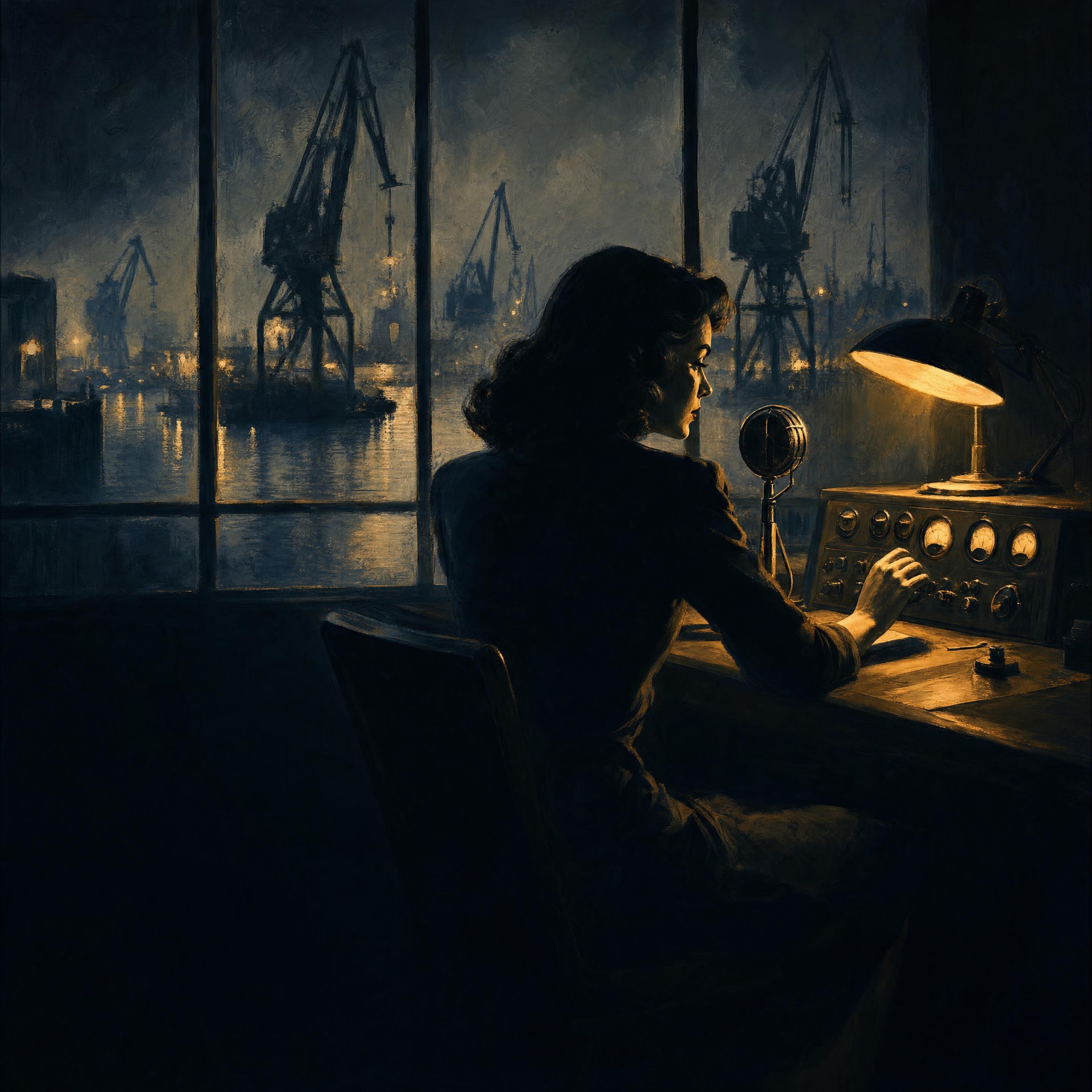
Ruth's flat was two rooms over the fish market, and the cold came up through the floor like it paid rent. The stove sat dark; the coal was measured out in a coffee can, and the can was mostly tin. Down the hall two kids slept the way only kids can sleep in a room that cold. Through the wall the foghorn kept its slow appointment with the harbor, and Ruth kept her hands folded on the table like she was holding them still on purpose.
You'll want to keep your coat on, mister. I don't light the stove till the little one wakes. Sit down. I'll tell you what they came and said, and then you can tell me I'm a fool for even weighing it.
I'm not in the business of calling widows fools, Ruth. Who came, and what did they say?
Two of the crew off the gate. They stood right there where you're sitting, hats in their hands, real gentle about it. They said if I call it an accident, straight out, no questions to the hall, then the marker's gone. Wiped. That thing my Tom signed his name into at the Blue Room, the one I've been holding since they carried him up the ramp. And my name stays on the call list, so I keep working.
They're not paying you in dollars, then.
No. It's the book. You've stood on the docks, you know how the men say the word, quiet, like it can hear them. Dollars I could turn down; I've turned down plenty. But that book had its hand around Tom's throat, and now it's offering to open the fingers. For nothing but my silence.
So I want you to say it, to my face. That I'd be wrong to take it. Because I'm sitting here doing the sum, mister, and the sum keeps coming out the same, and I need somebody besides me to have said the word out loud before I do the thing I'm about to do.
She wanted absolution, and she'd come to the wrong church. I looked at the dark stove, and the coffee can, and the two small shapes down the hall, and I could see the arithmetic working behind her eyes the way it works behind every widow's eyes in January. Take the deal, and the winter has a bottom. Cross the book, and it doesn't. She wasn't asking me to change the sum. She was asking me to sign the answer, so she wouldn't have to be the only name on it.
Segment four · The Last Brick
The pattern was there if you laid the accidents end to end — three men, three winters, the same brake, the same shrug from the same company. I had it all but the last inch, and the last inch had a name. Ruth's name. I was halfway into my coat to go get it when Dale looked up from her desk like she already knew where I was headed.
You've got the coat half on, sunshine, so let me guess the errand. You're going to sit in that woman's kitchen and tell her that keeping quiet is how she protects her kids. And you're going to call that mercy on the walk back.
It's her word that closes it, Dale. One sworn line. Without it the brake's just a busted brake and a company that's sorry for her loss.
So the whole wall comes down to a widow being brave enough for you. That's the ask. You knock, she talks, and she's the only thing standing between a killer and the gate. Convenient, how the bravest thing in the room is always somebody else's.
You want me to walk away from it.
No. I want you to answer the question you've been ducking all winter. What are you willing to spend, so the truth stands up without her name being the only brick in it. You've spent everybody else's brave this year. Frankie's stool's been empty a while now. Spend some of your own.
She wasn't wrong. She's never once had the decency to be wrong. I'd been about to build a case out of one frightened woman and call the draft a breeze. So I hung the coat back up and got out the repair log instead — the tampered brake, the company's own ledger, the two men before Ruth's husband. Make it iron first. Make it so when she finally speaks, she's the last brick and not the whole wall — so she's not standing out there alone with only her nerve between her kids and the men who'd shut her up.
Segment five · The Word at Low Tide
Dead low tide, and the harbor pulled back off the mud like a sheet off something it didn't want found. Ruth stood at the end of the pier with her collar up against the cold, small and straight, the way a woman stands when she's already decided and hasn't told her knees yet. I had the two pins in my coat pocket. I'd come to show her they weren't just her word anymore.
Ruth. Look at these. This one came off the winch that took your husband. This one came off the rig that crushed Ackerman's hand two winters back. Same brake-pin, both filed down the same way, both signed out to the same man's hand in the same logbook. That's not one bad morning. That's a pattern. Your word isn't a lone woman against a boss anymore. It's the thing that puts iron under everything the log already says.
And if I say nothing? The crew took up a collection. They'll clear the marker on our flat, they said, quiet, out of respect for a dead docker. My little ones eat all winter and I don't have to stand in front of the commission and call a man a killer. That's what silence buys, mister. I've had it doing arithmetic at my kitchen table for three nights.
I know what it buys. I'm not going to tell you it's an easy thing. The pins make it true whether you speak or not. But the man from the commission is standing at the foot of the pier, and he can only write down what he hears out of your own mouth. I can't say it for you. Nobody can.
My husband hated a bought quiet. Wouldn't take a call-slip he hadn't earned, not even that last winter when we were hungry. If I take their collection I bury the man twice — once in the ground and once in a lie about how he went. I won't feed my children on that. Tell your commission man I'm ready. I'll say it plain and I'll say it once.
So she said it. Named the hand that filed the pin, named the winch, named the morning. And the moment the words were out, the gate went quiet around her — the same men who'd passed a hat for her kids found something to look at out past the breakwater, anywhere but her face. She handed the crew's envelope back unopened and kept talking to the commission's pencil, steady, while they cuffed the tamperer and walked him off the mud. The tide hadn't turned yet. Neither had she.
Segment six · The Warmer Berth Uptown
Morning came up gray over the harbor, the way it always does after the paperwork's done. The man who'd filed the brake down on that winch was in a cell by then, and the partner they'd hung it on walked out of the precinct with his name back and nothing else. That's the arithmetic of a good day in Calloway Bay. It never quite adds up to even.
Chronicle's on your blotter, sunshine. Page four, down in the corner where they bury the ones that turned out right. Winch man charged, partner cleared. They spelled both names correct, which for that paper is a miracle.
And the walking boss?
Not on page four. Not on any page. Word came up from the hall an hour ago. He's running the north pier now, the deep-water one, for that respectable outfit with the office uptown. Better berth, cleaner coat. Cost him one soldier to read the wind right. Cost him nothing at all.
So that was the shape of it. He'd given up the small man the second the ground shifted, the way a smart operator sheds a wet coat, and stepped into a warmer one uptown. The brake was no accident. The wrong man carried it a while. And the truth of who wanted those two dockers quiet got bought and paid for on a book nobody in this town will say out loud.
You want me to say it's a win, I'll say it. The widow got the accident cleared, her husband's name is clean. She just doesn't get him back, and the marker he signed is still open on that book. Clean conscience, cold winter. That's what she bought, and that's what it bought her.
She'd left a mitten on my desk. A child's, wool, one of a pair, the kind a mother knits when the calling's steady and the pay comes in. She'd been twisting it in her hands the whole time she talked, and she forgot it going out. I sat there turning it over while the office went cold around me. I'd forgotten to feed the stove.
Put it in the drawer. She'll come back for it.
Maybe she would. But that small hand it belonged to, come the first cold morning, wouldn't hear its father's name called at the gate. Nobody's would, on that book. My breath hung in the room like something I owed. Frankie would've known which berth the boss bought, and what it cost, down to the dollar. I didn't. I just sat there in the cold, holding a mitten too small to keep anybody warm.