

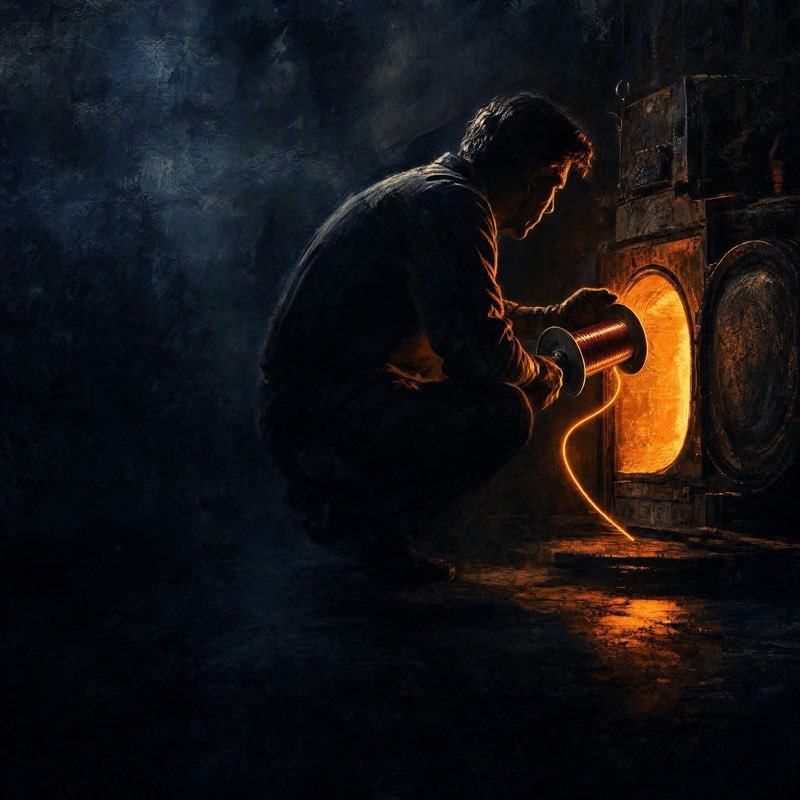



Wound on the Wire
One spool sits apart from the rest, wound tight and labeled in a dead man's hand — the reel somebody was willing to kill to stop.
Pinned to the Corkboard and will not be contradicted by a later case.
Closed for good. The dead stay dead, and the canon is append-only.
Segment one · Voices in the Dark
There now — that's your own voice, friend, plain as a photograph. [chuckles] A dollar a week and it stays here, safe with me, instead of strolling into the wrong parlor. Cheapest insurance in Calloway Bay. Same time next month, hm?
The wire hissed and the dead man kept selling. Emmett Soll had a voice like warm oil poured slow, and he had been face-down on the mission floor a full week — long enough for the flies to lose interest. All that survived of his enterprise sat in a shoebox of steel spools, and the woman who had hired me held it like a poker hand she meant to bluff to the river.
Friendly fellow, your partner. Sold absolution behind a mission wall and charged for the receipt.
That's Emmett. My partner, detective, back when the verb still worked. He recorded every soul that broke down in the forgiveness room, and then he rented them back their own sins. By the inch. I kept the books. He kept the box.
And now you keep the box. The police kept the corpse and never thought to look behind the pulpit.
Which is why you are standing in it and they are not, Mrs. Roan's compliments. I want the man who put Emmett on that floor. You find me his name. I will manage what the wire is worth after.
There it is. The name for me, the inventory for you.
She had a way of not answering that answered plenty. And while her mouth ran cool as tap water, her hands did a small thing the rest of her pretended not to notice — lifting one reel clear of the others and setting it apart on the bench, careful, the way you would move a thing that might go off.
These you may take. Play them, burn them, I don't care. But this one stays wound. Don't ask me why.
One spool sat apart from the rest, wound tight, a name I couldn't read scratched across the paper band in a dead man's hand. Whatever was on it, Vivian Roan wanted it kept — and somebody in this city had already killed a man to keep it quiet. In my experience, those two facts are never strangers for long.
Segment two · Absolution by the Inch
You want the arithmetic of it. Emmett never blackmailed a living soul — blackmail is a threat, detective, and a threat gets you a knife in the ribs. He sold a service. A man confesses in the dark, walks out feeling clean, goes home to his supper. Then he learns his clean little secret is wound on a wire, and that he can rent it back. A dollar a week. Absolution by the inch, forever.
You make it sound tidy, Mrs. Roan. Most rackets do, right up until the ribs part.
The nook behind the forgiveness room was the size of a confessional and smelled like one — dust, candle wax, and the particular sweat of men telling the truth for the first time in their lives. Vivian Roan stood in it in a good coat and discussed damnation the way other women discuss the grocer's bill.
Nobody argues with his own voice, you see. That's the beauty of it. A man will call you a liar all night. Play him himself, and he goes very quiet and reaches for his wallet.
Somebody argued. Somebody argued clean through Emmett.
Somebody who understood the machine better than the marks did. A wire that hangs one man clears the next. You hold the reel, you hold every frightened soul wound onto it. Emmett held it. Now I do.
And the man who put him on the floor — what was he coming to buy?
The cheap seat. Some two-dollar sin — a crooked card game, a wife he knocked around. He came back to lift his own grubby little spool off the shelf, and Emmett wouldn't sell the same secret twice. So he took it. And took Emmett with it.
A nickel sin. The kind this town forgives before breakfast.
Don't look so grim, detective. Every spool in that box still draws rent — the frightened pay in dollars, the law would pay in a different coin, and a wire is worth exactly what the living will spend to keep it quiet. Emmett died over the cheapest reel in the box. Now go and imagine what a man would do for the dear one.
Segment three · What the City Won't Pardon
The Chronicle kept its dead downstairs, in a morgue that was not a figure of speech — row on row of yellowing paper, every sin the city ever printed and half the ones it wished it hadn't. Flynn of the Chronicle worked it like a man who had filed the bodies himself, which in a way he had. I brought him a scrap I had caught off a wire and a year to hang it on. Flynn did the rest.
Give me the year again — thirty-one? Thirty-one, thirty-one, hang on, it's in the K drawer, kidnappings — there. Oh, God, this one. You don't forget this one, detective. You just stop saying it out loud at parties.
Refresh a man who tries to.
Little girl. Six years old. Lifted right off her own front steps for ransom. Family paid every dime and did it quiet, exactly like the note said. And they sent her back anyway — in a culvert, out past the flats. The whole coast went sick over it. Circulation tripled and every one of us hated ourselves for it.
And nobody swung.
Nobody was caught. Two men worked it. One turned up in the harbor before the grand jury, courtesy of persons unknown. The other walked off into the fog and stayed there. [scoffs] You know this town, detective. It'll pump a bootlegger's hand and re-elect a thief with both. But a man who takes a child for money and hands the family back a body? There is no buying that one back. Not here, not with money, not ever. That is the single crime this city sends you to the chair still remembering your face.
This fog fellow. He leave a face behind him?
Description's thin. Gray. Soft-spoken. Gentle-mannered, the witnesses kept saying — that's the part that keeps you up nights. The kind of fellow who says thank you and honestly means it.
Gentle-mannered. Gray. Says thank you and means it. I had shaken that hand three days back, in the mission yard, over the top of a push broom — a soft old caretaker who blessed me for a quarter and looked like he had never raised his voice at anything alive. Flynn was describing a stranger out of thirty-one. I was looking at a man I had already met.
Segment four · What the Wire Kept
The nook behind the forgiveness room was the size of a coffin and smelled like one — hot solder, dust, and the harbor coming through a crack in the wall. I threaded the marked spool by the light of one bulb and let the motor take it. Steel wire hissing off a reel is the loneliest sound a machine ever made.
Then the dead man's machine gave me a living one's voice. Amos Teller. The caretaker who swept the yard and never once raised it above a whisper. He didn't know he was talking to anything but the dark.
I've never said this whole, not to a soul, not in ten years of trying. But it starts with a boy. Somebody else's boy. We took him for the money his people had, and I told myself the whole time that no harm would come to him.
Harm came to him. [sighs] It came while I stood in the next room and did nothing. I have washed this floor a thousand mornings since, and it does not come clean. That's the thing nobody tells you about penance — you do the work, and the stain just learns your name.
A kidnapping that ended with a child in the ground. In this city they'll shake your hand over a killing if the timing's right — but that one they strap you to the chair for, and the chair never asks how sorry you got. Somewhere a machine had been sitting in the dark, hearing everything, the way Frankie Slim used to hear things down by the docks before the city pulled him out from under the el. Except Frankie only remembered. This thing kept it.
I let the reel run to its tail, where a man ought to find nothing but slack. That's where the second voice came in.
Soll. I want the spool with my name on it. All of it — the wire, the copy, whatever you've got. I'm not buyin' it twice.
Put it down. Put the — no. No, you don't get to smile at me. Not you.
Then a sound I'd know anywhere, gone flat and small the way the wire made everything small — a man being killed by the very machine that sold him back his sins. Soll had recorded his own murder without meaning to, the last honest work he ever did.
I shut the motor off and sat with it in the dark. One reel. Wound onto it, in order, a murderer's voice and a good man's damnation, so tight you couldn't cut one loose without freeing the other. Hand the law its killer, and the same turn of wire walks Amos Teller to the chair for a boy dead ten years. The city would call that justice. I'd already met justice. It never once came cheap, and it never came clean.
Segment five · Ten Years of Quiet
Careful on the flags there, mister — I just hosed 'em down. You come to see Mrs. Roan, or you come to sit a spell in the sun?
Amos Teller. The mission's caretaker, ten years at the same broom. Three days back I'd let him bless me for a quarter and thought nothing of it. Since then I'd matched that soft gray face to a clipping out of thirty-one, and now I couldn't unmatch it — the gentlest man in Calloway Bay, and I'd come to sit with him the way you'd sit with a snake you'd already decided not to kill.
I'll take the sun. They tell me you keep this whole place standing, Teller.
I keep the coffee hot and the leaks off the cots. The standing, that's the Lord's work. Sit. Sun's mean on a man who works indoors.
He poured me water from a tin pail like he'd been saving it all morning for whoever wandered in. Whatever Amos Teller had been out in the fog of thirty-one, he'd worn it down to a man who fretted over the sun on a stranger's neck.
Long stretch, ten years at one broom. A man could walk off any morning. Nobody's got you chained.
Where's a man walk to? Everybody comes in off that water carrying nothing. That's the door. You keep coming back till the nothing takes hold.
And it took.
Had a dog out here, winter before last. Somebody left it under the pier, ribs like a washboard. I fed it till it slept warm by the furnace.
Yours, then.
Come spring, a fella swore it was one he'd lost. Wasn't, I don't figure. But he wanted it bad, and I'd had my winter with it. So I let it go with him.
Gave it back to a stranger. After you carried it up from nothing.
A thing you save, mister, you don't get to keep. [sighs] You just get to have saved it. That's the whole of it.
I thanked him and stood, and my coat pulled heavy on the one side. Wound tight in the pocket over my heart was Amos Teller's whole black life, every yard of it — steel wire enough to walk him to the chair twice over. And the man himself sat there in the good clean sun with a rake across his knees, no more idea it existed than the dog had.
Segment six · A Killer for a Saint
The forgiveness room had a back nook the size of a confessional, and that's about all it ever was. A table, a lamp turned low, and a wooden box full of steel spools, each one wound tight around a man's worst hour. Vivian Roan sat behind it with her hands folded, patient as a pawnbroker who already knows what you came to sell.
You found me Soll's killer, shamus. That was the job. So set the reel back in the box, tell me the name, and we're square.
The name's on the wire, Miss Roan. Same wire your partner used to sell these folks their sins back at a nickel on the dollar. The man who put Soll down came back to buy off his own cheap little spool, and he's on the reel doing it. His voice hangs a killing on him all by itself.
Then you've got what you need. Play it for Brogan's replacement, collect your fee, and leave the rest of the box where the rest of the box earns.
She said earns the way other people say breathes. To her the box wasn't evidence and it wasn't sin. It was inventory, and it had passed to her hand as clean as a deed changes owners — Soll to Vivian, and next to whoever was holding it when the music stopped.
Here's the part you built and didn't mean to. The killer and the caretaker are wound on the same reel. Amos Teller confessed the one thing this city never forgives — a child, a ransom, a grave. I can't hand the law the murder without handing them Teller. Play one voice, they hear both.
Then the arithmetic's simple, and it isn't mine. A killer for a saint. Give them their murder and Teller goes to the chair for a thing twenty years buried. Sit on your hands and the killer walks free. Either way — [under her breath] the wire keeps both of them, and I keep the wire.
A man can be forgiven a great many things in Calloway Bay if he's got the money and the manners. Not that one. This city sells absolution by the yard and it still won't sell him a foot of it.
Now you understand what you've been standing in. So make your choice standing there, and put the box back before you do.
I'd fed a man's name to a fire once before — an old list of sellouts, gone to ash in my own stove, and I hadn't slept clean since. But some ledgers you close by not writing in them at all.
I'm taking the whole box, Miss Roan. Killer, saint, and every poor soul in between.
Then carry it out knowing what it is. That isn't a box of wire, shamus. That's the leverage on half of Calloway Bay, and it belongs to whoever's holding it. [chuckles] You just made yourself the richest man in the city, and the loneliest.
She was right on both counts, and that was the trouble with Vivian Roan — she was always right about the price and never about what a thing was worth. I picked up the box. It weighed about as much as a good conscience, which is to say more than a man wants to carry and less than he can put down.
Segment seven · A Hand's Length at a Time
I was younger than the boy's father, and twice as certain. We told the man Tuesday. [exhales] Tuesday came, and there was nothing left of the boy to hand back.
That was Amos Teller's voice, ten years and a whole different man ago, coming off a dead crook's machine in the mission furnace room. New Dawn burned its trash in an iron box off the yard. Tonight I was burning something the city would have paid a fortune to keep whole.
I fed it in a hand's length at a time. Steel wire doesn't go up like paper. It browns first, slow, the way a photograph left in a window goes — and then it's just heat, and a man's worst hour is warmth on your knuckles.
I've knelt on it every morning since. A man can be forgiven — I believe that now, I've had to. But the state doesn't take confessions. The state takes men.
He was upstairs asleep, the real Teller, the remade one, and he'd said all this into a hidden reel he never knew was turning. This is the one thing Calloway Bay never pardons — not for money, not for a decade of penance. Give the law this wire and they'd give him the chair for a boy already thirty years in the ground.
If there's a ledger up there, put it against me. Not against the work. The work is the only clean thing I ever made.
I've fed a name to a fire before — a sellout list, curling in my own stove, some other man's night I decided nobody needed to know. My hands remembered the weight of it. Lighter than you'd think. That's the trouble.
The man who put Soll under was on the same reel, one lesser spool he'd come back to silence. Kill the dead man's confession, you kill Teller's with it — they're wound on the same wire. So the killer keeps his name. Soll's murder goes to the pile marked open, where this city keeps the questions it would rather not answer.
The last of it curled, went brown, and was gone — a whole life turned to warmth and a smell like a shorted socket. I lit a cigarette off the same heat and thought the ugly thought I'd been ducking all night. Wire is cheap. A quiet room where the desperate come to confess is on every waterfront in America. The racket didn't die with Soll, and it didn't die in that furnace. Somewhere a second recorder is already waiting for its first penitent to sit down and start talking.
Segment eight · One Word Short
You've got ash on your cuff, sunshine. The whole sleeve of it. And you smell like a furnace that lost the argument.
Dale had the desk lamp on and the rain doing its two-in-the-morning work against the glass. She looked at me the way she looks at a column that won't add up — which is to say she'd already added it and didn't care for the total.
Long night.
They're all long lately. [scoffs] But you don't come home smelling like a chimney unless you burned something. What'd you burn?
A wire. A dead man's whole racket, wound on one spool. It had the name of the man who killed him on it, plain as a photograph.
So you walked it to the precinct and you're home early with a fee. No. You burned it. Why in God's name would you burn the one thing that closes it?
Because the same wire that hangs the killer hangs a caretaker who's spent ten years being sorry. One reel. Couldn't give them the one without the other.
She went quiet then. Dale does her arithmetic faster than I ever managed mine, and she'd reached the bottom of the column before I finished the sentence.
So you didn't clear a murder and you didn't hang a killer. You stood in a basement, all by yourself, and decided which man this city gets to forgive — and then you burned the proof it ever had to choose.
Somebody was going to be holding that reel by morning. Better a man who'd rather burn it than spend it.
[sighs] Maybe. Doesn't make you clean, sunshine. Just makes you the one who was holding the match.
So. What do I put in the file?
Murder. Party or parties unknown. Unsolved. And that's even the truth, mostly—