



What the Night Line Heard
She presses a wax disc into his hand — the one shift the charity's men were too quick to collect, the record of the night her sister died at the board.
Pinned to the Corkboard and will not be contradicted by a later case.
Closed for good. The dead stay dead, and the canon is append-only.
Segment one · Nobody's Angle
You're the shamus who works for folks that can't pay. That's what the girl at the diner told me, so here I am with nothing in my hand and no story to sell you. My sister ran this board. She didn't die of her heart.
The Good Samaritan line had gone dark at midnight and it hadn't warmed back up. No hum, no ring, just cord and cold coffee and a woman at a dead switchboard, waiting on it like it might light for her one more time. She had the operator's own jaw and none of her sleep. Six years that voice had answered strangers in the dark for free, and now the room around it was quiet as a shut church.
Vera never missed a night. Six winters, not one. Sick, snowed under, the night our mother went — she came in and she plugged in and she listened. They found her here Tuesday, slumped in the chair with the cans still on her ears.
And the men who run the line?
Called it her heart. Had a doctor of their own say so before I could get down here. Had the room swept and sealed by morning, all polite, all sorry, all so fast. You don't seal a room that fast for a bad heart, mister. You seal it for what's in it.
I kept waiting for the turn. In my trade every client walks in with an angle folded up small, and sooner or later they shake it out at you. I sat there and waited for hers, and it never came — just a tired woman telling me a plain thing and meaning every word, which in this city is rarer than a straight cop.
I don't want money back. I don't want a man hung. I want to know what my sister heard through those cords that was worth doing this to her. That's all. Just — what she heard.
Charity work doesn't usually get a woman killed, Miss Coyle. What makes you think she heard anything?
Because of this. She sewed it into the hem of her coat, the one shift their men got to before I did. They collected everything else off that board by dawn. They missed the coat.
She pressed it into my palm — a black wax disc, light as a dinner plate and twice as cold. One shift. The one night the charity's men had been a half-step too quick to clean up after. Whatever went dead in that room on Tuesday had gone dead with the cutter still running, and I was holding her sister's last hour. It was starting to feel heavier than it weighed.
Segment two · What the Wax Kept
Are you there? Good. It's only me again. I've told you things I never told a living soul, and you never once told me to stop. So I'll tell you the last of it. There was a man who knew what I was. I met him down at the water, and I saw to it he went in and didn't come up.
That was the voice on the wax. Not a hood, not a shakedown artist — a soft, careful man confessing a murder to a night operator the way you'd confess to a priest, because she was the only soul who ever just listened. The Good Samaritan board took down every call that crossed it, they said, for training. So Vera's kindness had teeth she never knew about. Every desperate thing anybody whispered to her, the machine kept.
I'd read a killing off a record exactly once before — years back, a man's last breath hiding under a church hymn, on a disc no judge would ever agree to spin. The law doesn't recognize a dead voice. It didn't then. It wouldn't now.
You want to know if a man can be forgiven, if he gives enough after. I've given a great deal. And another fellow wore my trouble for me — a better man than I am, God keep him. I only came here, night after night, to hear a kind voice tell me I might still be all right.
I played it again. And again. And the second time I stopped listening to the man and started listening behind him. There's a whole room in a telephone if you hush up and let it talk. A clock chiming the quarter-hour, close. An el-train passing at an even count, far off. A foghorn spaced slow and patient off the water. He'd left me the shape of the place he called from without knowing he'd said a word.
Now. There's one more thing, and then I'll let you go. Somebody told me tonight that you've been keeping the discs. That you kept mine. That won't do, my dear. That won't do at all.
The kindness in his voice didn't change. That was the worst of it. He said the thing that meant he'd come for her in the same soft tone he'd used to ask whether God forgives. Then the wax kept turning, the way it was built to, all the way to the end of her shift and past it.
There are sounds a person makes that I won't put words to. A chair going over. A small, surprised breath. A word that never finished. The cutter didn't stop for any of it — it took her down groove by groove, faithful as a clock, and then it ran out to the paper label and there was nothing left to take.
So that was Vera Coyle's last hour. A calm man's confession laid over a map of sounds — a chime, a train, a horn — and at the dead end of the wax, the noise of what he did about it, recorded because she'd built her whole life on listening and the machine never learned to look away. Two things a court would throw out. Two things I couldn't.
Segment three · Absolved on the Steps
Don't take your coat off — you'll want to be standing for this one. Flynn, Chronicle, back here in the morgue with the dead paper. You gave me a date and a stretch of water and a man in the harbor, and I've got your killing. Only trouble is the city already closed it. Closed it beautifully.
Flynn of the Chronicle lived down in the newspaper's basement the way other men live in a bottle — surrounded by everything that ever happened and none of it any comfort. He had a folder open under the lamp before I reached him, the flimsy pages going brown at the edges, and that hungry shine in his eye that meant he'd found money with blood on it.
Here. Three years back. Same water, same season. They never got a conviction — they got better than one. They forgave a fellow for it. Right up on the cathedral steps, the whole town watching, a poor devil absolved in front of the flashbulbs as proof this city still has a Christian heart. He didn't do it. Everybody agreed he didn't do it. That was the beauty of it — they pardoned an innocent man and called it mercy.
You forgive the wrong man loud enough, nobody goes looking for the right one.
Now it gets good. That mercy had a sponsor. Same soul who bankrolls your midnight charity — the Good Samaritan line, the free ear for the wretched of Calloway Bay. Runs both. Funds the forgiveness on the steps, funds the phone that listens in the dark. And every call on that line gets cut to wax. For training. You believe that?
I've heard one of the discs.
Then you know what he's really got down there. Not charity — a library. Every throat in this city that ever cracked at three in the morning, filed and labeled and his. He's not a benefactor, he's a collector. And somewhere in his own collection is the confession to the very killing he stood up and forgave a stranger for.
There it was, whole. To open this killing back up wasn't to catch a man — it was to prove the city's own Good Samaritan had built his sainthood over a murder he'd held the confession to the whole time, wax-sealed in his cellar next to the flashbulbs. Vera had listened to the one voice that could burn him down. That was the thing she'd heard. That was what it cost her.
Segment four · By Its Noises
The first cool night off the water had come in low and gray, and the city wore it like a man wears an old coat. I walked with the disc's noises still turning behind my eyes. A blind man finds a door by the sound the hall makes around it. Tonight I was going to find a room the same way.
Under the man's calm little confession, the wax had kept a second story going. An el-train, close, coming through every four minutes and a bit. I stood on a corner off Harrow and let three of them pass, counting the gaps in my head. Four minutes and change. This was the line. This was the stretch.
The harbor sent up a foghorn while I stood there — two long, then a rest, then two long again. On the disc it had come in soft and far, the horn heard through a window, not off a pier. So: near the water, but back from it. A few blocks in. I'd narrowed a city to a neighborhood, and I hadn't shown a single soul my face.
There'd been a third thing under the horn and the train — a low, steady beating, a heartbeat that wasn't a heart. It took me half the walk to place it. A press. A newspaper press, or a job-shop's, running the late run and thumping the pavement through the soles of my shoes. I followed the thump the way you follow a smell to a kitchen.
It brought me two streets over, to where the pressroom light spilled yellow on the wet and the thumping got honest and loud. I had my train, my horn, my press. Three walls of the room. I only needed the fourth, and the fourth was the one that had bothered me most, because it didn't belong with the others.
A clock. One chime, a single sweet note on the quarter-hour, the kind that lives in a hallway that gets dusted. Not a dive's clock. Not a flophouse. You don't hear a good hall clock over a dockside racket — the two don't share a street. Unless the street turns. Unless a decent block sits right up against the noise and pretends it can't hear it.
I heard it for real, then, from somewhere to my left. One note, clean, over the thump of the press. I turned up the side street and the noise fell off behind me like a door closing, and there it was — a quiet block, swept stoops, curtains in the windows, a chapel clock keeping the hour for people who slept nights. And on the corner, under a good lamp, a payphone.
The train ran behind the rooftops. The horn came in soft, back from the water. The press thumped under everything, and the sweet clock counted the quarter I'd just missed. Four walls. I stood inside the room the sounds had built for me, and the room was a phone booth on a decent street where nobody killed anybody.
That was the thing about it. A man who calls a mercy line at three in the morning to confess and be forgiven for free — he doesn't call from an alley. He steps out of a warm house, walks to the corner in his slippers, and dials. The voice on that wax had a face, and the face had a good address, a stone's throw off. All I had to do now was knock, and find out which one of these swept stoops belonged to a killer the whole city called a decent man.
Segment five · Nothing on the Shelves
The Good Samaritan line ran all night for the desperate of Calloway Bay. A kind voice in the dark, and no charge for it. I came back to the board in the gray hour and found the shelves stripped clean. Somebody had come in the daylight, polite as pallbearers, and carried the whole archive off on a hand truck. Every disc. Every sin the city ever wept down a wire. For the privacy of the callers, the paperwork said. The rack where Vera Coyle used to sit was empty as a Monday collection plate.
They didn't even dust, mister. You can see where the discs stood. The felt's darker where they sat. Nine years my sister listened to this city, and they took it out on a cart.
Miss Coyle. You shouldn't be here. Men who move that fast in daylight don't care for witnesses standing in the room after.
I'm not here to be brave. I wanted to stand where Vera stood. The building man let me in. He's sorry too. Everybody's sorry. Sorry's cheap this year.
I braced for the angle. The free door has trained me to wait for a woman's second sentence, the one with the hook set in it. It never came. She just stood in the cold with her sister's chair and meant every plain word she said.
You've got something. I can tell. You've been holding your coat shut against your chest since you walked in, like a man carrying an egg.
One disc. The night she died. Their men were quick, but they weren't perfect. It's the only wax left in this city that still matters.
Then tell me, and don't be gentle about it. I've had gentle all week. What did my sister die to keep?
I looked at the stripped rack, and at the woman who wasn't playing an angle, and I felt the disc against my ribs, warm off my own heartbeat. One night's confession. One voice a court would never spin. Vera Coyle had died to keep a killing on the record, and I was the last man in Calloway Bay still holding the record. I didn't have the heart yet to tell her that keeping it might cost as much as she already had.
Segment six · A Sin Already Forgiven
Come in out of the fog. I know your face. You've been asking after me by the sound of my telephone, block by block. Sit down. Mr. Ansel won't bite. I'd offer you a drink, but I don't keep it in the house.
The druggist kept a parlor like a pressed collar. Everything squared, a doily under every lamp, a little clock on the mantel that chimed the quarter hour. The same chime I'd chased across three foggy blocks to a payphone. He poured tea he had no intention of drinking and watched me the way a chemist watches a scale settle.
You found me by my noises. The el at twelve past. The harbor horn. This little clock. Clever work. Vera never knew where I called from. You do. It won't do you a particle of good.
You called that line for years. Told a kind woman the worst thing you ever did, night after night, because she'd listen for nothing. Then you learned she kept the wax. So you went down to the board on her last shift.
I did. I killed her at the switchboard. I put my hands around the one voice that never charged me a cent for the hearing, and I stopped it. And do you know, the cutter was still turning. She recorded her own end. I've sat with that. It doesn't trouble me the way you're hoping it does.
There's a man in this city they forgave for that killing. On the cathedral steps, flashbulbs going, a bishop's hand on his shoulder. Your killing. He wears it like a coat he can never take off.
They forgave him. That is the beauty of the thing. What the city has already forgiven, it cannot un-forgive. It would have to stand up in front of those same flashbulbs and admit it was wrong. My confession is the safest property I own, detective. It has already been absolved, on another man's back.
I have your voice on wax.
You have one disc, and it is already sold. The gentleman who runs the charity has paid handsomely to see the whole archive locked away, for the privacy of the desperate, he says. Yours goes into the dark with the rest. Carry it in your pocket the rest of your days. It will never sound in a room that counts. Do you know what a listening ear is worth in this town? I learned the figure. Vera charged nothing. The man with the vault charges everything. Nothing in between was ever going to save her.
Maybe. But there's one door your money didn't buy. Tonight I walk to that forgiven man's flat, and I sit at his table, and I tell him to his face that I know he never did it. He's spent a year being the man the city pitied. He walks out of tomorrow with one person alive who knows the truth and will say it to him plain. That's not for sale, Ansel. I'm handing it over for free. The way she did.
Then hand it over. One man's belief in a kitchen. It clears nothing, it prints nothing, it opens no cell. He stays the man they forgave. You'll have told a sad fellow a secret, and I'll still pour my tea in the morning. Go on. Do your one free thing. It's the only kind this city lets you do twice.
He confessed to my face a third time and topped off the cup, not a tremor in the china. He'd done the arithmetic the city had taught him, and it came out clean every way but one. A sin already forgiven can't be charged twice; a truth no court will spin is the same as no truth at all. I stood up, and I left the disc in my coat where it would stay, and I carried the one thing out that door the vault could never lock away, a thing worth almost nothing in Calloway Bay, and the only coin the whole rotten machine had forgotten how to take.
Segment seven · Free Doesn't Fit
Sit down before you fall down. The coffee's terrible and it's the only honest thing in this place. That's your face when you've solved it and it doesn't matter. I know that face, sunshine. I've been filing it for years.
Dale found me at the counter of an all-night diner where the coffee was scorched and the pie was older than the case. She'd come out at three in the morning because I'd telephoned and said nothing, which she reads better than most people read a signed confession.
So talk. You've got the killer, you've got his voice cut into a record, and you're sitting here like a man who lost his shirt at the track. Which is it, then.
Both. He confessed to my face. I can't play it anywhere on this earth. The charity bought the silence, the whole archive's bound for a vault, and my one disc rides in with it.
A machine that waxed every drunk and every sinner in Calloway Bay for the benefactor's scrapbook. Kept every last word. And the one voice it wouldn't keep was the woman who listened for nothing at all.
Vera Coyle. She took the desperate for free. No charge, no ledger, no angle.
Free. There's the whole rotten joke. This town will wax your confession, file it, and sell it back to you at interest. But a thing given for nothing, a woman who just listened, that's the one thing it throws out with the ash. Free doesn't fit on the ledger, so the ledger won't carry it.
I did what I could with it, Dale.
Don't. Don't dress it up as a fight you lost. That's just one more way of making it about you. Somebody paid tonight. Say who. Out loud, to my face.
A dead woman who listened for free. An innocent man who'll wear another man's murder to his grave. And her sister, standing in an empty room over a chair nobody's sitting in.
And not one name on that list belongs to anybody who did it. That's what tonight cost, sunshine. Drink your coffee before it's colder than the rest of this.
I drank the coffee. It was as bitter as everything else she'd set in front of me, and just as true. In a city that waxes every whispered sin against a rainy day, the only voice worth saving had been the one that never asked for a thing, and that, Calloway Bay would not keep. Free was the one price this town would never meet.
Segment eight · Play It for No One
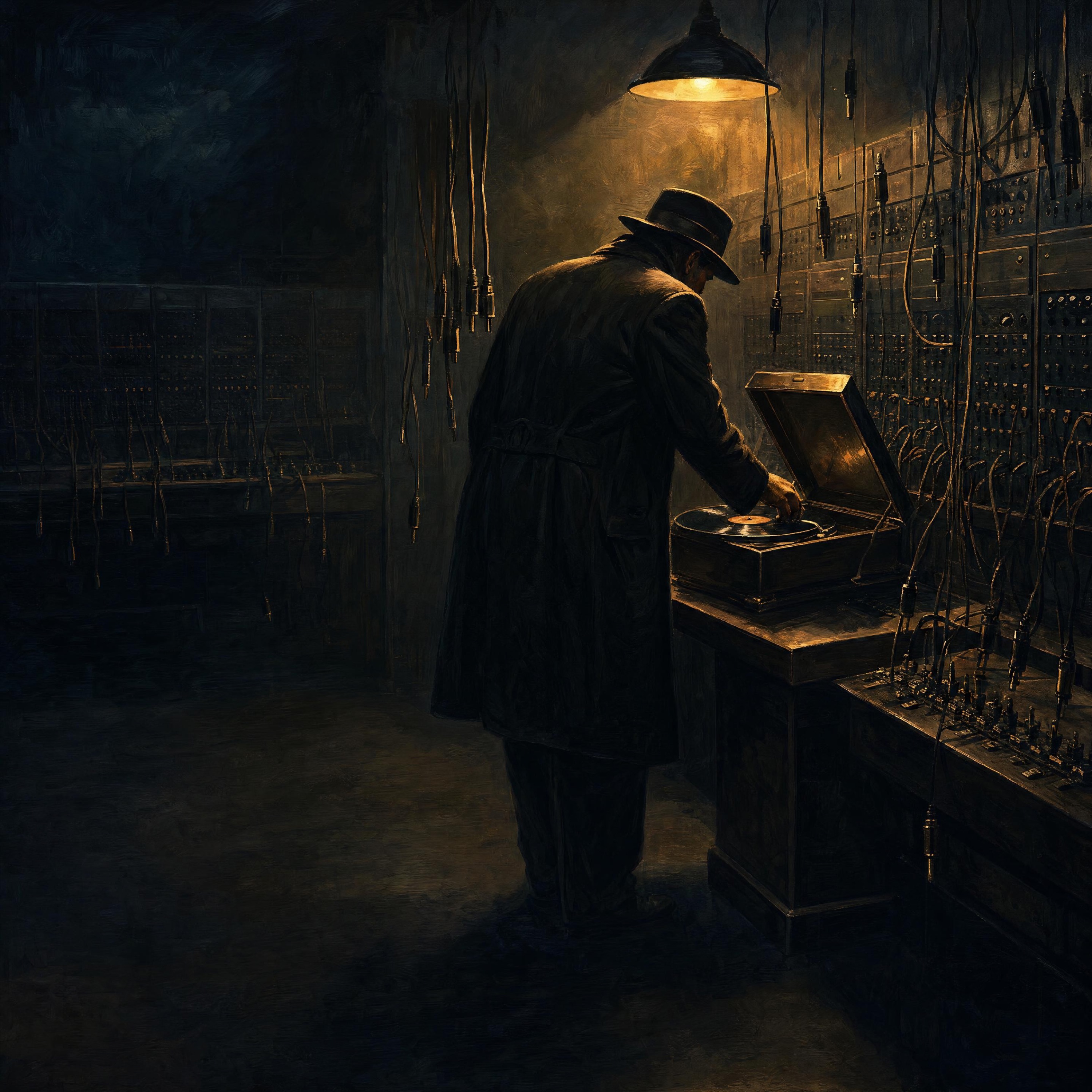
The collector's men would come for the board at first light. Tonight it was mine. A room full of dead cord, fog cooling the glass to milk, and the chair where Vera Coyle used to sit and take the whole sorry city in for nothing. I set her last disc on the turntable. Not for a court. Not for the sister. Not for the man they'd forgiven on the cathedral steps. Just for the dark, where she used to listen.
I'd read a killing off wax once before, years back, under a hymn, and the law had no use for it then either. I dropped the needle. It hissed, found the groove, and the druggist's voice came up as calm as a man reading his own grocery list.
I killed the operator. She listened to me for years and never once asked me for a thing, and when I learned she'd kept my voice, I came down to the board and I stopped her. I won't be sorry the way you'd like. The city has already forgiven a better man than me for it. I mean to let it.
The confession filled the empty room and landed on no one. No jury, no judge, no morning headline. Just me and the fog and a dead woman's cold chair, hearing a murder spoken plain by the man who did it, in the one place on earth it would never count for a thing.
I lifted the needle. The last words that wax would ever give up went quiet under my hand. He'd been sure of one thing on the phone that afternoon, unafraid, smiling into the wire: that this disc was promised to a vault and nothing I held would ever play. The men would come at dawn and count the board's whole archive, every desperate voice in Calloway Bay, and find it one disc short. This one went in my coat. No court in this town will spin it, and it clears no one, and it un-marks no man they've already branded. It only means the saint's machine ends the night missing the single confession it was built to keep, and that the murder of Vera Coyle lives somewhere its benefactor doesn't own. It doesn't balance the books. It just refuses to let him close them.