

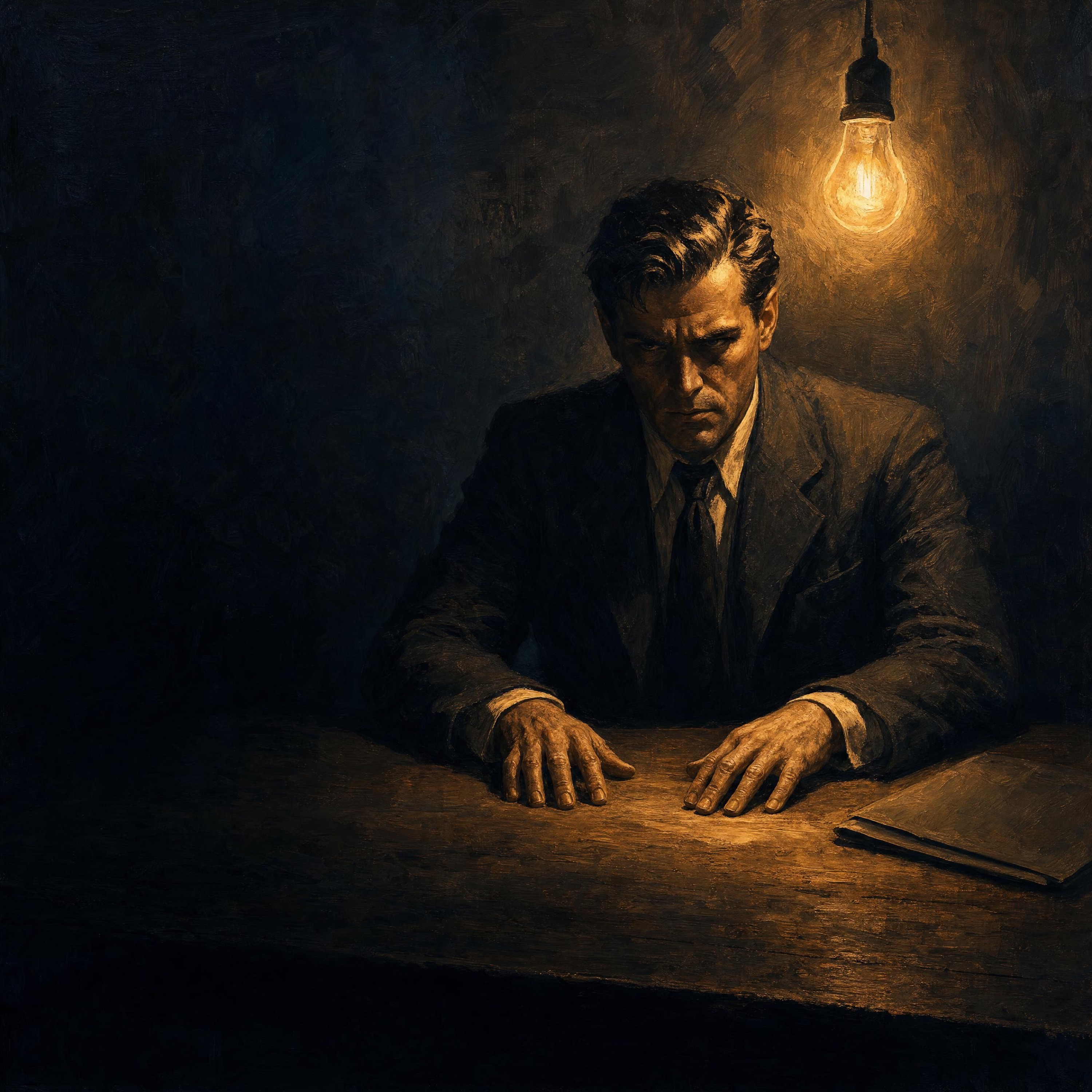



State Your Name for the Record
The nameless witness is sworn; the board turns to what he knows about the man seeking to be made new.
Pinned to the Corkboard and will not be contradicted by a later case.
Closed for good. The dead stay dead, and the canon is append-only.
Segment one · State Your Name
This hearing of the Calloway Bay reform board is called to order. It's warm up here and there's no fan, so I'll ask the room to bear it and be brief. You are the board's first witness. Raise your right hand. Do you swear the testimony you give will be the truth, the whole of it, and nothing dressed up?
I do.
Sit. State your full name for the record.
Occupation, private investigator. Office on the third floor of the Hollis Building, the frosted door at the end of the hall. Six foot, a hundred and seventy pounds. Gray eyes, if the record wants them written down.
That is a description. It is not a name.
No. It isn't.
Your license is on this table in front of me. The city verified you head to foot last winter — the height, the weight, the eyes. Every line on the form filled but one. The line for a name was left blank.
Blank was the only true answer they had. I didn't hand them a different one to make the form look finished.
The record will show the witness answered in every particular but the one, and that the board did not press what the city itself could not fill. Very well. You were engaged this month. By whom, and to do what.
By this board's own clerk. To look into the man sitting in that chair — the one asking you to call him reformed. Twenty days and my fee, to tell you whether the account he means to give holds up.
Then you're sworn, and you're the only reason this board can weigh him at all. We'll hear what those twenty days told you about a man who wants to walk out of this room made new.
Segment two · Not One Wrong Note
I've said it to the same four walls every year: I took a man's life, and nothing this board signs will hand it back. I only ask to be weighed by the twenty years since, and not by the one hour that started them.
The board hears the applicant. We'll come to the twenty years — the board takes a life in the order it was lived. Start with the night. You were how old.
Twenty-six. It was raining that whole week. I remember the rain better than his face now, and I've made my peace that the shame of that is mine to carry.
Tell it the way you carry it. The board will not stop you.
There was a quarrel over money that wasn't worth a man. I struck him once. I meant to hurt him and I did not mean the rest, and I've learned the difference doesn't buy me anything. When it was done I stood in a doorway out of the rain and I waited for the morning.
That waiting. Between the blow and the morning — that hour. Walk the board through it, minute by minute if you can.
I won't gild it. I felt nothing I could put a name to, not then. I smoked what I had. I watched the water come down the glass. The feeling everyone wants to hear about came later, and it has never once let me sleep through since. But in that hour — nothing. Only the rain.
Most men falter here. Their voice goes, or they look at their hands. You give me that hour as smooth as the rest.
I've told it a thousand times, ma'am. The thousandth telling doesn't shake. Maybe that steadiness is the very thing you're sitting there to weigh — whether a man that practiced is healed, or only rehearsed.
The stenographer has every word of it, and the account is complete. I'll note only this for the record: that it never once caught. Not even in the hour where, in every other man who's sat in that chair, it does.
Segment three · What the Morgue Kept
The board calls the press and reminds it that it's under the same oath as any other witness. You are Flynn, of the Calloway Chronicle. You've asked to enter the paper's own file. On what standing.
On the standing that the Chronicle keeps a morgue — every face the city's ever printed, filed by name and never once thrown out. A man can scrub himself clean in front of a board like this. The morgue doesn't scrub. That's the whole reason I brought it myself instead of mailing it.
Read into the record what bears on the applicant. Only what bears on him.
One clipping. Front page, below the fold, twenty years back. A booking photograph — the same man in that chair, younger, harder set around the mouth, the collar of a coat this room would not recognize on him now. The account he's given you this afternoon walks right past that photograph as if the shutter never closed.
You're entering it as what. Contradiction of his testimony.
As record, ma'am — nothing louder than that. I don't say the man lied to you. I say the paper remembers a face he's stopped wearing, and the paper is the one ledger in this room nobody in this town has ever managed to buy.
Then answer the board plainly. Does your file tell me whether that harder man is still inside the soft one who testified.
No. That's the one thing ink was never able to hold. A photograph fixes a face on the day it was taken and swears to nothing after. You'd need a living witness — somebody who watched him lately, off the record, in a moment he wasn't performing for a board.
The Chronicle has shown the board a gap and been honest that it can't close it. Note for the record that the gap remains — and that the board already has, sworn and seated, the one witness who might.
Segment four · The Bracketed Silence
The board recalls the witness. You are reminded you remain under oath. The stenographer will note the time; the room is warm, and I will not keep you longer than the record needs.
The record and I are both sweating, ma'am. Ask what you came to ask.
You were engaged to observe the applicant over the course of this past month. Privately. He did not know your occupation.
He thought I was a man who leased the room across the landing. We shared a hallway and a bad radiator. He was courteous about both.
Courteous. The board has heard that word from every other witness. His employer used it. His landlady used it. The paper's photograph could not use it, so it stayed silent.
A photograph's the one witness that never learned to shade a thing. I'll give it that.
Then let me narrow it, since we are both warm. A man performs courtesy when he knows he is watched. You watched him a month precisely because he did not know. I am asking about the man in the gaps. The stairwell at night. The moment between one door and the next.
You're asking a lot of a hallway.
I am asking what a hallway gives an honest observer. A man alone, believing the whole building asleep, is the only version of himself he keeps no manners for. You saw that man. Once. I have read your written report; it lists every day but one, and the one it lists gives an hour and no account of it.
The report says what I could set down cleanly. Some hours don't set down clean.
This board does not rule on the hours a man performs. It rules on the one he forgets to. Twenty years ago a man was killed by the applicant's hand — the paper remembers the face, the account remembers the sorrow, and neither can tell me whether the sorrow is his or borrowed. You can. You saw him when he thought the sorrow could rest.
I saw him on a landing, late, with nobody's eyes on him but mine, and he didn't know that.
The stenographer will take this verbatim. In that moment — the man believing himself unseen, keeping no face for anyone — what did you observe. The finding of this board rests on your answer, and I will have it in full.
The stenographer will note the pause. Bracket it. The witness has not yet answered. Take your time, detective. The record can wait; a ruling cannot be unmade.
Segment five · Dale Says It Plain
You've taken the oath. State your name and your position for the record, please.
Dale. I keep the front office for the detective who testified before me. Appointments, correspondence, and the door. Mostly the door.
The board isn't interested in your employer this afternoon, Miss Dale. It's interested in the applicant. You saw the applicant, in the course of the month the detective was vetting him. Is that correct?
Once. He came to the office to be looked over. I was at my desk. The detective had him in the inner room, and the door was open a crack, the way it gets on a hot day. You don't shut a door in July if you can help it.
And from your desk, through that crack, what did you see?
The detective asked him about the man he'd killed. Not gentle about it. Named him, named the year, watched his face while he did it. Some men flinch at that. Some men look at the floor.
And this applicant?
He reached over and moved his hat off the desk into his lap, so it wouldn't get sat on. Then he answered the question. Even voice. His hands were steady the whole time. Steadier than mine would've been.
Let me be exact, so the stenographer has it clean. At the moment the dead man's name was spoken aloud, the applicant showed you no reaction. Nothing in the face, nothing in the hands.
Nothing I could see. He minded his hat. That's the whole of it. I'm not telling you what it meant. I couldn't. I'm telling you what he did.
The board understands the difference, Miss Dale. That difference is the only reason we sit up here. Thank you. You've been plain, and plain is a mercy in this room. You may step down.
He'll want to know I said it. I'll tell him myself. He's never once thanked me for handing him the line he'd rather I swallowed, but I hand it over just the same. That's the job too.
So noted. The fact is on the record now, Miss Dale — bare, the way you gave it. What it weighs is for others to say.
Segment six · Twenty Years Under It
The board recalls you, detective. You were in the room. You heard the secretary's account just now.
I heard it. She doesn't miss. That's why I keep her.
Then you'll confirm it. The applicant was told of the killing, brushed his sleeve, and asked after the rain.
That's what happened. I was three feet from him.
The board is done with what happened. Now it wants your judgment. A man hears the worst thing he ever did and asks whether it'll rain. In your judgment, was he unmoved?
I've watched men hear a parking ticket and sob like widows. Tears are cheap. I've bought a few myself, cash on the counter. What I saw in that chair wasn't a man feeling nothing.
Then what was it.
A man who'd been carrying the thing so long the carrying didn't show anymore. You strap a weight on at twenty, and by forty you've forgotten you walk with a limp. He didn't ask about the rain because he was empty. He asked because he'd been standing out in it, alone, for twenty years, and a man gets so he'll talk about the weather just to have something a decent size to hold.
You're telling the board he was moved.
I'm telling the board what I saw, same as she did. She saw the sleeve. I saw the twenty years under the sleeve. Both are true. Only one of them fits in a sentence.
You sound certain, detective.
I sound like a man who's decided to be. In this town that's the closest thing to certain anybody's selling. I stopped waiting on the real article a long while back. Cost too much and never came.
Is there anything in that you'd change, or take back, before the board enters it?
No. Enter it.
The board enters the witness's judgment as given. A man carrying the weight, not a man who ever set it down.
The taking of evidence is closed.
Segment seven · Good Standing
The applicant will rise. The board has weighed all the testimony taken and finds as follows.
On the matter long standing against him, this board is satisfied that the man who did that thing and the man before it are no longer one and the same. His slate is ordered clean. On the record of this city, he stands restored to good standing.
Thank you, ma'am.
It's a close, hot room, and the board kept you in it a long while. There's water on the sill if you want it before you go.
I'm all right. I've sat in warmer rooms and waited on worse news.
Detective, the board thanks you for your testimony. It was given plainly.
It's yours now. You're welcome to it.
Is there anything you wish to say for the record before it closes?
Only that I'm obliged. To the board, and to the men who spoke of me. I won't waste what the day's given me. Whatever it turns out to be worth.
So entered. The applicant is restored, and this board stands adjourned.