

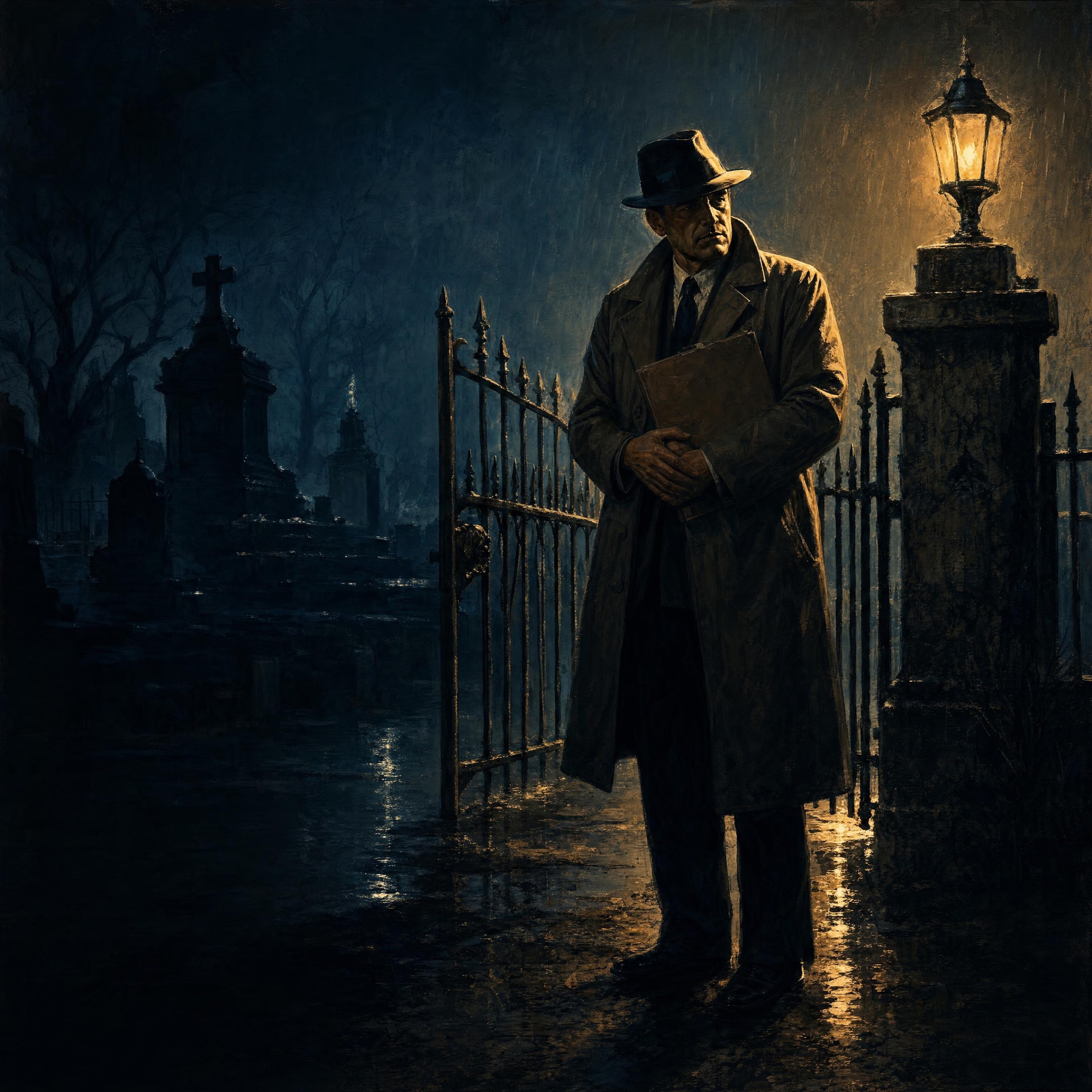



The Ground Won't Take Him
The society won't say what her husband did — only that he 'broke faith,' and that the ground the brotherhood keeps is closed to him.
This case aired inside one episode with Case 045 — The Man She Sent Me To. Tuning in here drops the needle at 12:42 — partway through the hour, straight into this case’s cold open — and plays on to the end.
In Apple, Spotify or Amazon the episode is the whole double feature — there is no separate file for this case.
Pinned to the Corkboard and will not be contradicted by a later case.
Closed for good. The dead stay dead, and the canon is append-only.
Segment one · Frost on Her Coat
It was the kind of January where the radiator gave up arguing with the window sometime before dawn. Then the door opened and let the winter in — a woman, small and straight in the back, frost still melting on the shoulders of a coat too thin for the season. She didn't sit down like a client. She sat down like somebody at a graveside who's been told to move along.
You are the detective. Forgive me — I have no money to give you. My name is Marta Sokol. My husband is three days dead, mister, and I have come not to hire you, but to beg you.
Sit, Mrs. Sokol. Nobody gets put back out in that cold for being broke. Take your time. Now what does a dead man want with a fellow like me?
A place to lie. The burial society — our society, the one he paid into every week for eleven years — they were to lay him in the churchyard, in consecrated ground. Three days ago they struck his name from the book. Now there is only the pauper's field for him. The frozen dark, with no stone, no prayer. He was a good man. He was a good man, and I do not understand the shame.
Societies don't cross a paid man out for nothing, Mrs. Sokol. Somebody told them something. What is it they say he did?
That is what I cannot tell you. I asked the steward. I asked the men who sat with him at cards for eleven years, men who ate at my table. Not one of them will look at me. They say only three words, always the same three. That he broke faith. Broke faith — and then they close their mouths as if it were a door.
Broke faith. Three words and a shut door, and a widow with frost on her coat asking me to open it. I took it for what it looked like — a name and a plea, the cheapest and heaviest things anybody ever brings a man like me. I should have known better. In this quarter, the things nobody will say out loud are always the ones already dug in and waiting for the thaw.
Segment two · What the Book Won't Say
Flynn of the Chronicle took his coffee the way he took everything — fast, black, and already looking past it to the next thing worth a headline. I found him in a café down in the quarter, the kind of place where the windows wept steam and the linoleum could remember better decades than this one.
Well, if it isn't the last honest gumshoe in Calloway Bay. Sit down, I'll buy you the second-worst coffee in the neighborhood. What's a downtown shamus doing this far into the old streets? You don't come to the quarter for the atmosphere.
A burial society, Flynn. One of the little brotherhoods. A member of theirs turned up dead this week and they scratched his name out of the book — said he broke faith and then went quiet as a church. You know the quarter better than the census does. What breaks faith with an outfit like that?
With that kind of society? Only one thing, and it isn't the ten commandments. Those funds run on pure trust — no bank, no bond, just a steward and a book and every man's word that the pot'll be there when they lay him down. Touch the money and you've touched all of it. And here's a thing for your notebook — last winter, the coldest one, that fund came up short. Quietly short. Then, just as quiet, it got squared. Nobody made a sound.
Squared how? Money doesn't crawl back into a poor man's box on its own two feet.
No, it doesn't. And funny you should sit down across from me the same week I've been chewing on this — that same season, a member of that same brotherhood got sold to the company. Somebody carried his name. He never drew steady work off those docks again. Two winters, one little society. You want me to believe those are two different stories? Because, friend, you've got a face on you that already stopped believing it.
There they sat, the two facts, side by side on a chipped café table like they'd come in together and hung the same coat. A hole in the fund, filled by a hand nobody saw. A man sold to the company to be filled with. I didn't want them to be the same man. Flynn watched me not want it, and he had the decency not to say the thing we both already knew — that they were, and had been all along.
Segment three · The Smallest Grave
The churchyard sat behind a low iron fence with the paint peeling off it like old skin. The sexton told me the ground was too hard to open — that they had a man dead and waiting because January wouldn't give up its dead-room, and the pauper's field was the only earth soft enough to take him. I walked the rows anyway. A detective walks. It's the one thing we're good for when there's nothing left to ask.
And then I found it, near the wall where the light gives out early. A stone from last winter, the letters still sharp. And a plot in front of it no longer than a bread box — too small for a man, too small for anything but the smallest kind of loss. Somebody had paid hard to open frozen ground for that little box, a winter ago, when by every account the society had already spent its year's limit burying the poor. He hadn't waited for the pauper's field. Not for this one. Not for his own.
In her coat, back at the office, when she'd reached for a handkerchief that never came, I'd seen a corner of knitted wool folded small against the lining — a christening bonnet, kept close, that he could never once bring himself to lay in the ground with the child it was made for. I understood the whole ugly shape of it then, standing in that cold. He'd robbed the fund to buy his baby out of the pauper's field. And then, before the book got counted, he'd sold a brother's name to the company to put the money back. It wasn't greed. God help him, it was grief wearing greed's coat.
So there it was, complete, and no amount of walking was going to un-know it. There's no way to tell a truth like that one where it doesn't cost the living more than it ever clears the dead. Standing over a grave the size of a bread box, with my breath hanging in the air like a thing I'd said out loud, I wished to God I'd never come out into the cold to find it.
Segment four · In Good Standing
Marta Sokol came back the next evening with the same thin coat and the same straight back, and I had a decision made up before she got the door shut. Some cases you close by telling all of it. This one you closed by choosing what to keep.
It's done, Mrs. Sokol. I brought the steward proof the fund was made whole — every cent that ever went missing came home, and I can show the ledger where it landed. No theft. No hole. There's nothing left in that book to keep your husband out of the ground. He'll lie in the churchyard. Consecrated, with the stone and the prayer. In good standing.
In good standing. Then he was a good man. I knew it — I told them, I told all of them, he was a good man. But the money, mister. The three words. If the money was always there, then why did they say he broke faith? What did my husband do?
He did what a lot of men do in a bad winter, Mrs. Sokol. He carried a weight he didn't tell you about. The rest of it's between him and the ground now. It won't touch you, and it won't touch the grave. That much I can promise you.
You are not going to tell me. I can see it on you — the way you looked at the wall just now. There is a thing you know, and you have decided I am to be spared it. My husband kept one thing from me. You keep it, too. I would rather bury the man I believed in for thirty years than spend the next thirty learning who else he was. Let him be good. Let me have that. I will not ask you again.
And she didn't. She buttoned the thin coat over the little knitted thing she carried and went out to bury her good man in ground that would finally take him. I let her go with it whole. Then I opened the drawer — the one where the winter's other spared truths already lay in the dark, waiting on nobody — and I filed the last of it there. A clean grave, bought and paid for with a lie neither of us would ever say out loud.
Segment five · The Weight in the Drawer
Dale came in with two cups and the particular quiet she saves for the nights she already knows how they went. She set one down in front of me and didn't sit, which is how I knew she wasn't going to let me pour syrup on it.
The widow's man goes in the churchyard tomorrow, Dale. Consecrated. She gets to keep him the way she wants him kept. Call it a mercy and let me drink my coffee.
I'll call it a lot of things, sunshine, but I won't call it a mercy, because mercy's the one you're reaching for so you don't have to hold the real one. You didn't spare her anything for free. You bought that woman a clean stone by agreeing to be the only man alive who knows what's actually under it. That's not mercy. That's a bill, and you signed it.
The society keeps its faith. The quarter stays whole. She keeps her good man. Somebody had to carry the rest of it out of the room, Dale. It might as well be the fellow with the drawer for it.
That's just it. A whole brotherhood gets to say its faith was never broken — every man of them — because one man who was never in it agreed to hold the break by himself. They keep it clean because you consented to keep it dirty. Don't dress that up. Just know you're the reason the word still means something to them, and it cost you the only part that was true.
Drink your coffee. It's your second, and I'm not counting tonight.
I told her the ground finally took him. That was the win, if we were still calling them that — cold dirt agreeing to open for a man who paid too much to keep another man out of it. Dale said the ground always takes them; it's the living who keep deciding, year after year, what to remember and what to leave folded in the dark. Then she went home. And the drawer where I keep the winter's buried things sat one small weight heavier than it had that morning.